Banks Stainless Boost Tubes for the 4G Tacoma
By Bob Ulrich — videographer and 2024 Tacoma Trailhunter owner behind Portal Hunter
Only stainless charge pipe kit on the market for the 4G Tacoma. 409 stainless tubing, 5-ply Nomex couplers, billet quick-connects. Why Banks bet on materials instead of chasing a dyno chart, and where their uniform-diameter sizing trades against textbook stepped sizing.
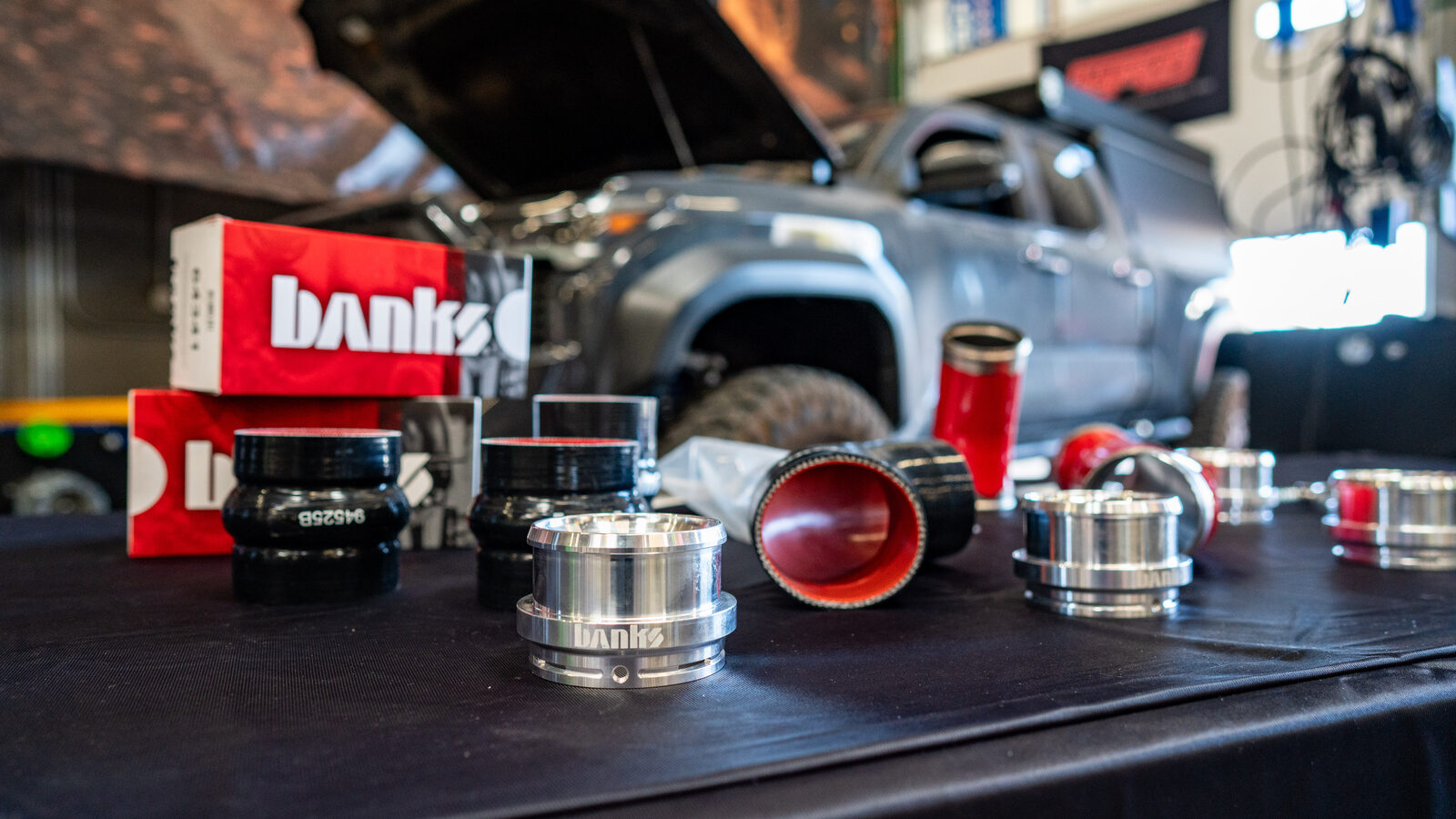
A charge pipe is the part that carries pressurized air across the engine bay, from the turbo to the intercooler and back to the throttle body. Banks treats that piece as the opening move of a full airflow build on the 4G Tacoma, ahead of the intake, intercooler, and exhaust upgrades still on the roadmap. Toyota plumbed the factory version with rubber tubes and aluminum end caps, a mass-production cost choice that aFe, Mishimoto, K&N, and Banks have all entered the market to improve on.
Banks built that first piece differently from everyone else. Their Boost Tube Upgrade Kit (PN 26012) is the only kit in the field made from 409 stainless steel rather than aluminum, where aFe, Mishimoto, and K&N all run aluminum tubes, and it pairs that with 5-ply Nomex-infused silicone couplers and billet aluminum quick-connect adapters. It runs $498 (MSRP $553.33), fits the 2024-2026 Tacoma (gas and i-FORCE MAX hybrid), 2025-2026 4Runner, and the hybrid Land Cruiser, and installs in about an hour with no tune.
Banks does not publish a dyno chart for this specific part, and that is the tell. Their bet is not peak horsepower; it is a charge path built to outlast the factory rubber and sized for where the platform is going rather than where it sits the day you bolt it on. Banks treats the 26012 as one piece of that larger system, starting with the Ram-Air Intake covered previously.
Part 1 of 4 / The Airflow Build
Follow this build and you get the before-and-after dyno numbers nobody publishes. Four parts, run in order: boost tubes here, then intake, intercooler, and exhaust. Each component gets dyno’d before and after, so you see what the full airflow upgrade does together and what every piece adds on its own. Boost tubes start it off as the foundation. A charge pipe alone barely moves the needle, and the numbers grow across the series.
Charge Pipes 101
On a 4G Tacoma, the turbo compressor pushes air out under pressure and at high temperature. Charge pipes (also called boost tubes) carry that pressurized air across the engine bay to the intercooler, then back to the throttle body. Two pipes do the work: the hot side runs from the turbo outlet to the intercooler inlet, and the cold side runs from the intercooler outlet to the throttle body. Every coupler and every bend on that path is a chance to shed a little pressure to flow restriction.

Rubber tubes with aluminum end caps cost less to produce at mass-production volume than mandrel-bent aluminum or stainless, and the rubber flexes to absorb engine motion, a job aftermarket metal kits hand off to their silicone couplers. Aluminum at the connection points carries the clamp load where each tube meets the turbo outlet, intercooler ports, or throttle body inlet. On a mass-market turbo platform with multi-year warranty obligations and a stock duty profile, those tradeoffs make economic sense.
Whatever the material, the charge path still has to hold boost to the throttle body, keep charge-air density up, and seal at every coupler. Those are the variables a charge pipe either protects or compromises.

Owners modifying the truck (towing trailers up grades, running a snorkel that traps engine bay heat, fitting larger tires that load the turbo harder for the same vehicle speed) operate outside that duty profile, stressing materials, geometries, and heat cycles the OEM kit was not engineered around. 4G Tacoma launched in 2024, so there is no long-tail forum data yet on whether the factory tradeoffs show up as a measurable problem at high mileage; Banks, aFe, and Mishimoto are betting that those owners want headroom built in, not chasing a documented OEM failure pattern. Aftermarket kits bracket two weaknesses in the factory plumbing.
Flow restriction from packaging-driven geometry
OEM rubber tubes use tighter bend radii to package around a tight engine bay. aFe published a measured flow gain of up to 12% on the hot side and up to 5% on the cold side over OEM with their aluminum replacement (Stage 3 Motorsports writeup of aFe data), which is third-party evidence that factory geometry has measurable restriction at the part level. Boost pressure is what the throttle body actually sees after that restriction. The restriction win comes from smoother bend geometry, not from oversizing: a stock turbo does not flow enough to be restricted by a 2.5-inch hot side. Where geometry does cut genuine restriction, the turbo can in principle hit the same boost target with slightly less work, what Banks calls lower shaft speed for a given boost. The charge pipe is a small slice of total system restriction, so treat that as a direction, not a number you will feel, with Part 2 putting an iDash on it to see whether it shows up at all.
Heat-cycling stress on rubber tubes and joints
Rubber-and-aluminum junctions are cheap and quiet at delivery and absorb engine motion well, with rubber softening at the bend and joint wear at the clamp as the long-term cost. Banks’ stainless tubing plus 5-ply Nomex couplers is forward-looking material headroom, not a fix for a documented failure.
A good kit swaps OEM rubber for mandrel-bent aluminum or stainless and moves the rubber-and-clamp joint to higher-temperature silicone couplers on T-bolt clamps. Where packaging allows, it also opens up the bend radii. Better geometry trims restriction; better materials survive the heat cycling. Sizing is the one variable that stays a genuine tradeoff rather than a strict upgrade, which is where Banks parts ways with the field.

The 26012 addresses both: mandrel-bent 3-inch tubes for the geometry side, and 409 stainless plus 5-ply Nomex couplers for material headroom.
Here is how the major options for the 4G Tacoma compare on materials, claimed power, dyno transparency, and price:
| Charge Pipe Kit | Material | OD (Hot/Cold) | Couplers | Claimed Gain | Dyno Published | MSRP | CA Legal |
|---|---|---|---|---|---|---|---|
| Banks 26012 | 409 stainless steel | 3” / 3” | 5-ply Nomex silicone | Qualitative | No | $498 | EO D-161-173 |
| SXTH Element | Aluminum | 3” / 3” | Silicone | Qualitative | No | ~$399 | No (not exempt) |
| aFe BladeRunner 46-20724 | TIG-welded aluminum | 2.5” / 3” | 5-ply silicone | +10 HP / +11 lb-ft | Yes | ~$572 | No (not exempt) |
| Mishimoto Performance | Aluminum | 2.5” / 3” | DuraCore silicone | up to +10 HP / +9 lb-ft | No | $446.95 | Not stated |
| K&N Charge Pipes | Aluminum | Not published | Not published | +4.5 HP / +5.2 lb-ft (guaranteed) | Yes | $629.99 | No (CARB) |
On the OD column, the stepped kits (aFe, Mishimoto, K&N) drop to 2.5 inches on the hot side, the textbook dimension, while Banks and SXTH run a uniform 3 inches. Smaller on the hot side keeps charge velocity up and gives the turbo less volume to fill, which is what spools quickest on a stock truck. A 3-inch hot pipe is the bigger number, not automatically the better one, until the turbo flows enough air to use it.
Banks is the only stainless entry in the category, and the clamp is the reason. Banks built its name in diesel performance, where street trucks run far more boost than a gas Tacoma and constant-tension T-bolt clamps are standard practice to keep couplers from walking off the tube under pressure. A constant-tension clamp keeps its grip as the joint expands and contracts through heat cycles; a worm-drive clamp does not, and backs off over time. Clamp load that high also bites into a soft aluminum bead and works it loose over years, where 409 stainless holds its shape. That clamp-interface durability is the clean win for stainless, not charge-air cooling. Banks also runs mandrel-bent 3-inch diameter on both the hot and cold sides where aFe, Mishimoto, and K&N step down to 2.5 inches hot, the unusual call covered below.
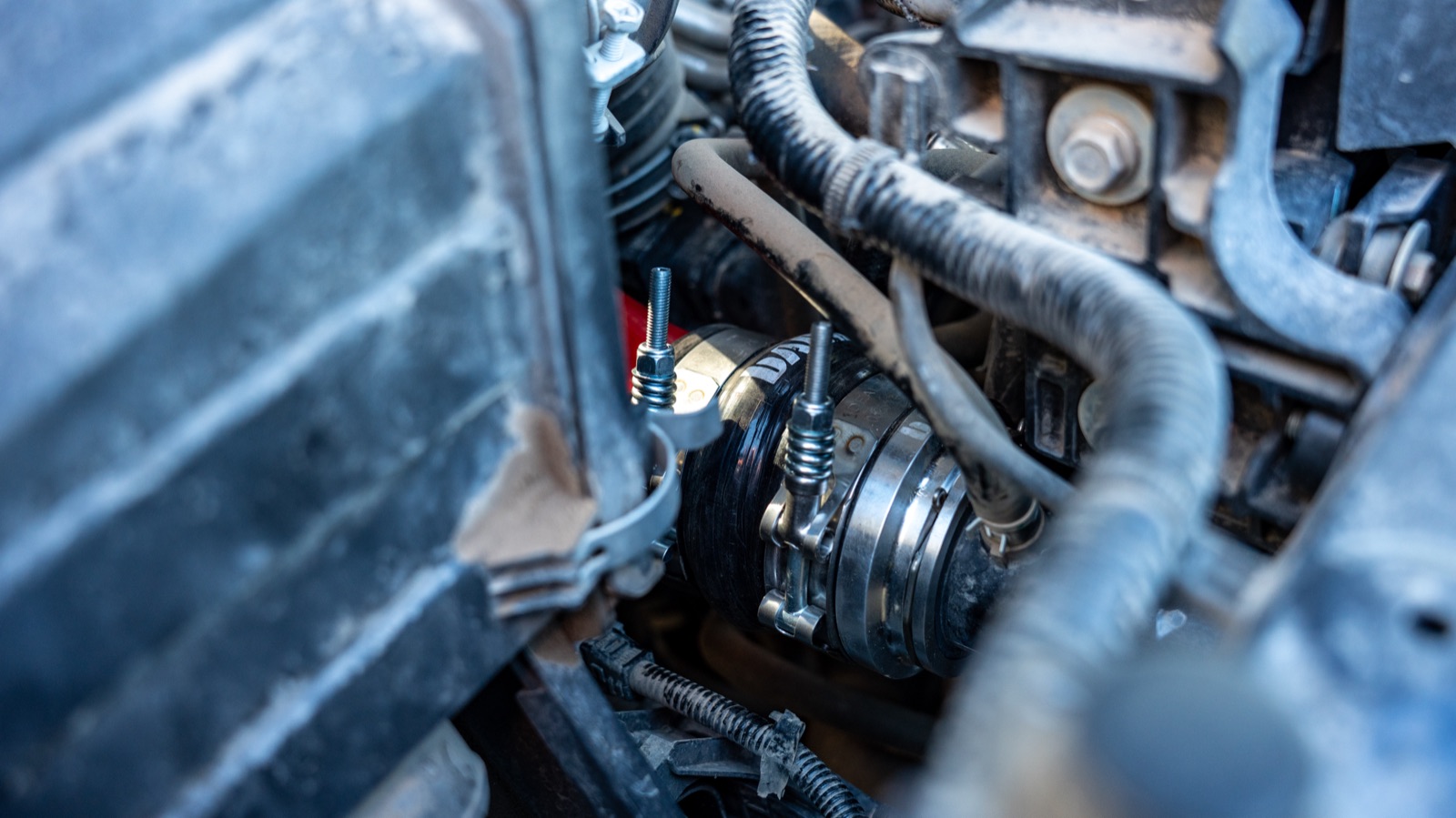
Video: How Banks Built the Boost Tubes
Banks has an install walkthrough video on the 2025 4G Tacoma, embedded below. SDHQ Off-Road fitted the 26012 to this i-FORCE MAX Trailhunter.
The Engineering Behind the Materials
Banks’ own engineering rationale is laid out in Banks Insider News on the Toyota high-flow boost tubes and the combined intake + boost tube upgrade article.
Uniform 3-Inch Diameter
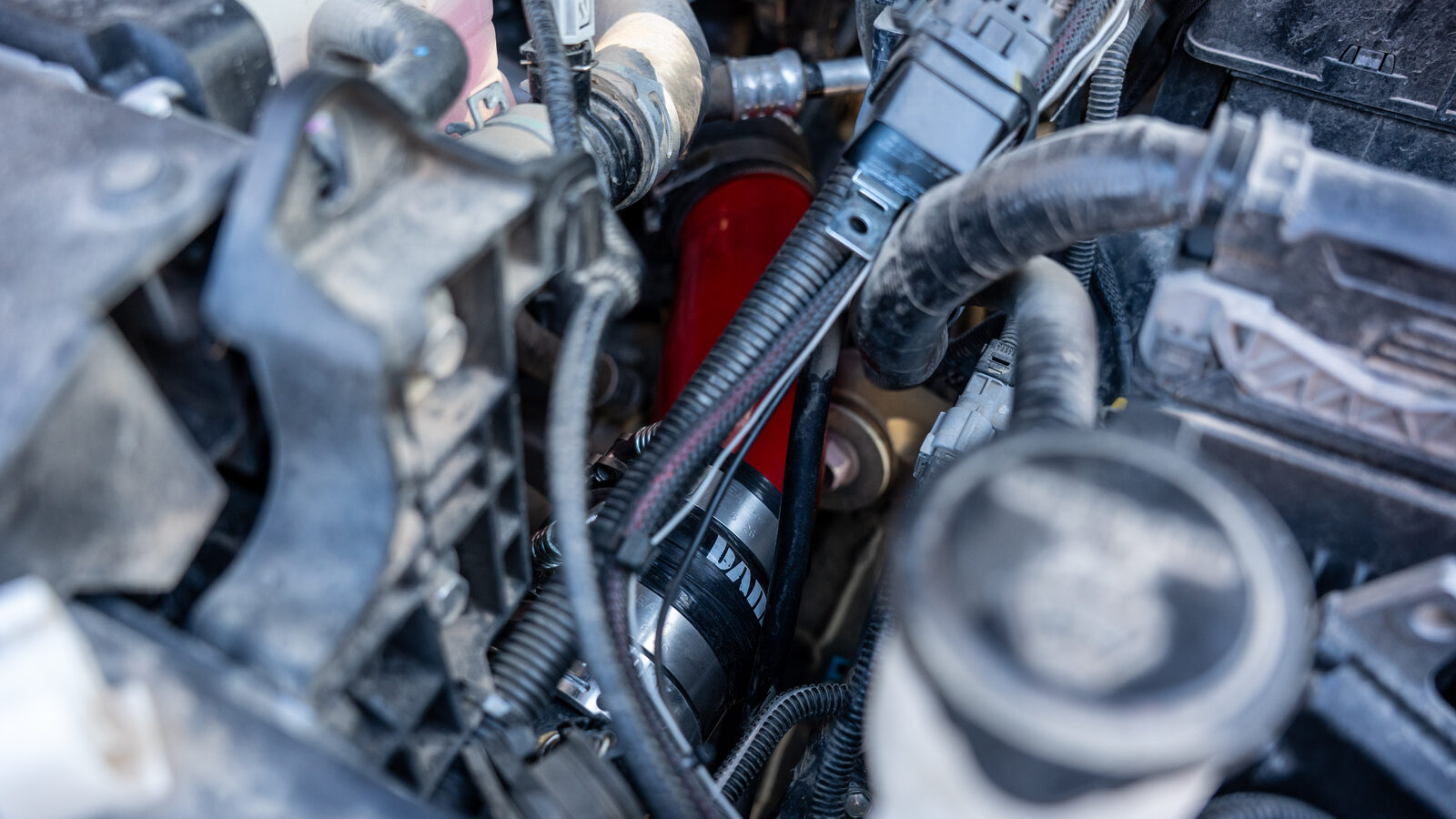
Banks runs a full 3-inch outside diameter on both the hot side and the cold side, the largest charge-air pipes in the field. The stepped kits drop the hot side to 2.5” to chase the quickest possible spool on a bone-stock truck. Banks built for the whole airflow path instead: a uniform 3-inch bore carries more charge volume, runs with no internal diameter steps, and is already sized for where a build is going rather than where it sits the day you bolt it on.
That last part is the point most reviews miss. Once the turbo side of the build flows more than stock, whether through a bigger turbo or the breathing parts Banks is developing, the 3-inch hot pipe carries it without becoming the next restriction. A 2.5-inch hot side does not. You buy a charge pipe once, and sizing it for the build you are growing into instead of the one you have today is the call that ages well. Pair that with the compliance story below and the uniform 3-inch reads less like an outlier and more like the kit engineered for the platform rather than for a dyno graph.
Compliance: The Job the Couplers Actually Do
On a 4G Tacoma the intercooler is a front-mount unit bolted to the chassis. Turbo and throttle body bolt to the engine, which rocks on its mounts under torque and over rough ground. Every charge pipe spans that gap, so beyond carrying boost it has to absorb the constant relative motion between a moving engine and a fixed intercooler. Compliance is the real reason Toyota ran rubber, and it stays the quiet job the couplers do on any kit that replaces it.
Here the design schools split a second time. Compliance is the couplers’ job: the engine moves on its mounts, the intercooler is bolted to the chassis and does not, and the couplers across that path absorb the difference. A longer coupler has more travel to give. Banks builds the 26012 with couplers left long at every connection, the conservative end of the range.
SXTH Element runs the same uniform 3-inch tubing, and per SXTH their coupler lengths match Banks at three of the four connections, so there is no functional difference there. They diverge at the turbo outlet: SXTH runs a straight coupler with the bend moved into the tube, and SXTH states they tested and verified ample flex at that joint, with a hump in the coupler that allows the needed movement. Banks keeps a longer coupler at that connection instead. Both are deliberate calls, and on a platform this new, SXTH’s own testing is the evidence that applies to their kit.
409 Stainless vs Aluminum vs OEM Rubber
OEM rubber flexes under boost spike and softens at the bend with sustained heat cycling over years. Aluminum (aFe, Mishimoto, K&N) is rigid, lighter than stainless, and conducts heat well; 409 stainless is heavier, more rigid, and conducts far less. Over a few feet of pipe the charge air spends too little time inside the tube for wall material to move intake temperature much either way, so the throttle-body temperature is set far more by the intercooler than by the pipe wall. Buy this kit for clamp-interface durability, not for charge-air cooling.
For an overland or Trailhunter buyer running a snorkel, dust intrusion at the tube exterior over years is a real consideration. Aluminum oxidizes superficially and stays cosmetic. 409 is a ferritic exhaust-tubing stainless, lower chromium than the 304 most people picture, chosen for heat-cycle fatigue resistance and cost rather than top-tier corrosion resistance. It resists corrosion better than carbon steel, though bare 409 can surface-rust in salt, so the powder coat carries part of the corrosion story here. Clamp-point heat-cycle fatigue is the clean win: steel holds a fatigue endurance limit that aluminum lacks, so the repeated clamp-load cycling a charge pipe sees is duty stainless shrugs off and aluminum works toward a crack over time.
5-Ply Nomex Couplers
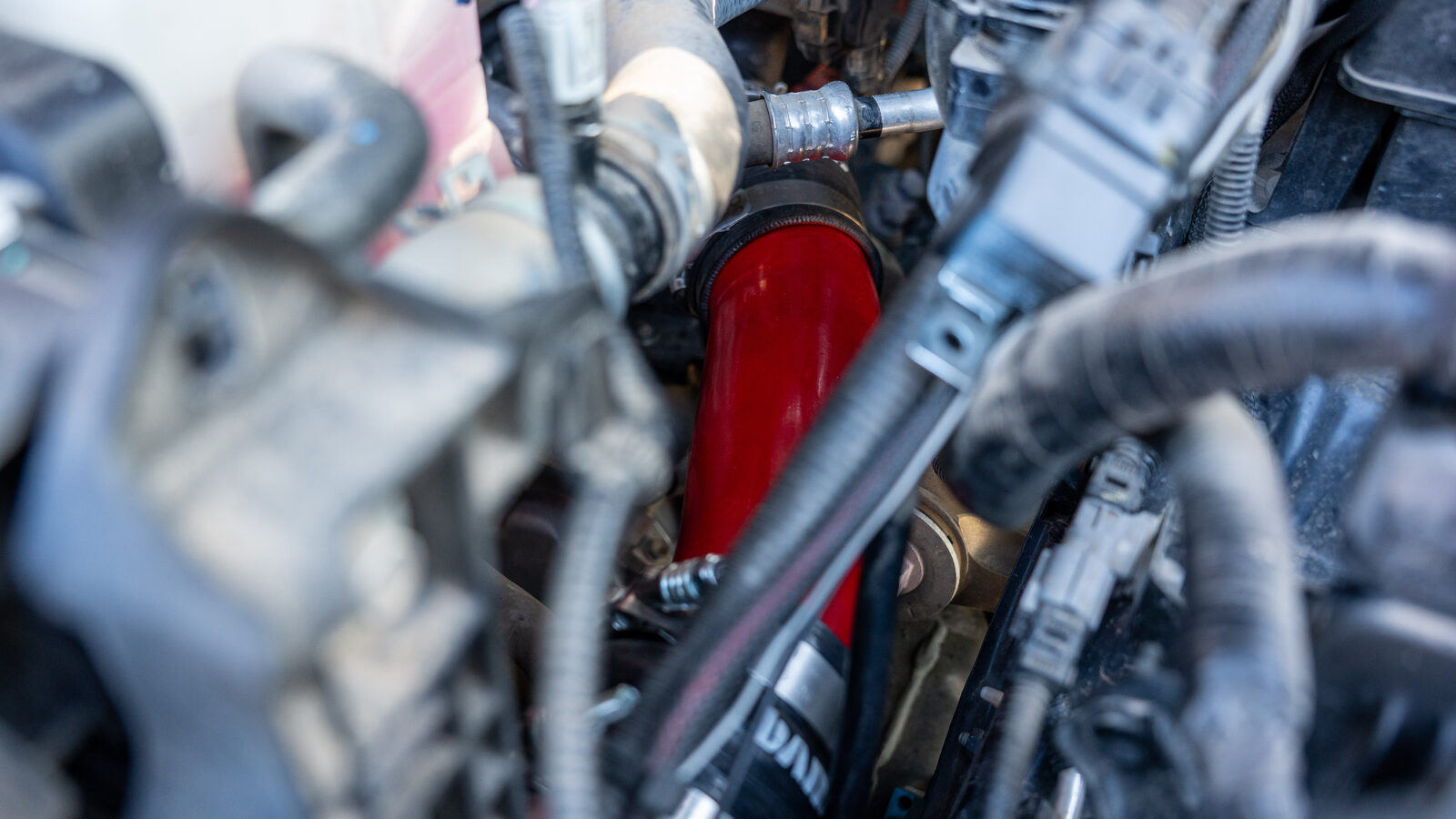
Couplers and clamp interfaces are common wear points on charge pipe kits. Banks’ couplers add a Nomex inner layer (the same DuPont fiber used in firefighter turnout gear and racing suits) that pushes the continuous-temperature ceiling higher than standard silicone and resists abrasion at the clamp interface. That fifth ply adds burst margin over the 3-ply or 4-ply on most aftermarket silicone. At stock boost a competent 4-ply is already inside its rating, so this is headroom, not a cure for stretching anyone is seeing at factory boost.
aFe also runs 5-ply silicone. Mishimoto runs their proprietary DuraCore silicone with a synthetic interior layer rated for heat, oil, and fuel exposure. K&N does not publish coupler ply count or material on their product page.
Billet Quick-Connect Adapters
Each adapter is machined from billet aluminum with factory-style quick-connect geometry, so it mates to the OEM compressor housing and intercooler ports without modification. Its interior radius is smooth enough to skip the small step that two-piece adapters leave at the junction.
No Tune Required
This is a pure hardware upgrade. No ECU flash, no MAF scaling, no fuel-trim work, and the turbo, intercooler, throttle body, and ECU all stay stock. The kit does not touch the metering path or the ECU’s boost target, so whatever small restriction change the new pipes make sits well inside what the factory closed-loop fuel control already corrects for, since the ECU meters fuel to measured airflow.
Install is roughly an hour per Banks’ own owners manual 97768. Tools needed: 10mm, 11mm, 12mm sockets, 3mm hex driver, flat-head screwdriver, torque wrench. Clamp torque spec is 60 in-lbs, with a 3/4” gap maintained between tube bead and billet coupler so the assembly does not migrate under boost.
Fitment
Part #26012 fits the following:
- 2024-2026 Toyota Tacoma (Gas and i-FORCE MAX Hybrid)
- 2025-2026 Toyota 4Runner (Gas and i-FORCE MAX Hybrid)
- 2024-2026 Toyota Land Cruiser (i-FORCE MAX Hybrid)
Banks lists fitment by model and year, so every turbo trim on the years above is covered, Trailhunter and TRD Pro included. Banks calls out the hybrid (i-FORCE MAX) explicitly, where some competitors list a blanket “2024+ Tacoma” and let the buyer infer hybrid compatibility. $498 (MSRP $553.33), limited inventory per the product page.
The Charge-Pipe Field
Confirmed players for the 2024+ Tacoma / 4Runner / Land Cruiser turbo platform, gas and i-FORCE MAX hybrid: Banks, aFe, Mishimoto, K&N, and SXTH Element. Searches for Injen, AEM, HPS, Magnaflow, CVF, ETS, and BoostLogic in this specific application returned no products as of May 2026. HPS and Magnaflow make intakes and exhaust for the platform but not charge pipes.
Banks vs. SXTH Element
SXTH is the closest design match in the field: the same uniform 3-inch hot-and-cold sizing, billet OEM-type adapters, an aluminum tube, around $399, with a flow-first pitch. Per SXTH, their coupler lengths match Banks at three of the four connections; the two differ at the turbo outlet, where SXTH runs a straight coupler with the bend in the tube and states they verified ample flex, while Banks runs a longer coupler there. Clearer separators are material (409 stainless versus aluminum) and legality (Banks carries a CARB EO, where SXTH’s kit is not CARB exempt). Cheapest uniform-3 kit with a flow-first path is SXTH; the stainless, California-legal build is Banks.
Banks vs. aFe
aFe is the engineering-depth competitor, publishing both a dyno chart and measured flow data: +10 HP, +11 lb-ft, with flow up 12% hot side and 5% cold side over OEM. Their kit is TIG-welded aluminum with 5-ply silicone couplers and SmartSeal stainless clamps, around $572 street ($681 MSRP). One catch for California buyers: aFe states the kit is not CARB exempt and not legal for sale or use in California, where Banks carries an Executive Order. aFe wins on transparency and on stepped-diameter sizing, a real advantage on a stock truck today; Banks wins on stainless durability, on California legality, and on stack compatibility that only pays off if you keep building. Buyers choosing on dyno data and correct flow geometry go aFe; California buyers, and those choosing on materials and a future Banks stack, go Banks.
Banks vs. Mishimoto
Mishimoto runs aluminum at 2.5”/3” with their DuraCore silicone (synthetic interior layer for heat, oil, and fuel resistance) and CNC-machined quick-disconnects. Backed by Mishimoto’s lifetime warranty (non-transferable). Sale price $446.95. Mishimoto claims “up to +10 HP / +9 lb-ft” but does not publish the dyno. Mishimoto’s pitch is the lifetime warranty plus the lowest price in the field. Banks’ counter is materials and i-FORCE MAX hybrid SKU specificity.
Banks vs. K&N
K&N publishes a “guaranteed” +4.5 HP / +5.2 lb-ft at 4,000 RPM, the smallest claim in the field but the only one phrased as a guarantee. Their charge pipes are aluminum mandrel-bent with gunmetal powder coat. Coupler material, ply count, and clamp type are not published. Price $629.99 (highest in the field). Critical detail for California-resident readers: K&N’s charge pipe kit is listed as CARB-restricted, not legal for sale or use in California. Banks holds CARB EO D-161-173 for the 2024-2025 Tacoma with 2026 approval pending, the only documented California-legal kit in this comparison: K&N is restricted, aFe is not CARB exempt, and Mishimoto makes no California statement.
What Could Be Better
No published dyno chart for this specific part
aFe publishes one, Mishimoto claims a number without backing it, K&N publishes a “guaranteed” floor. Banks leans on qualitative claims (“quicker spool,” “lower turbo shaft speeds,” “huge increase in volume”) rather than a chart. Those claims are plausible, but a part built this carefully deserves the numbers behind it. Part 2 closes the gap with iDash-measured before/after boost and intake-temp data, and a baseline dyno alongside the materials story would put the question to rest.
Wall thickness not published
Banks does not state the stainless wall thickness on the product page or in the owners manual. Material is 409 stainless, but how thick is the tube? aFe and Mishimoto do not publish wall thickness either, so this is a category-wide gap rather than a Banks-specific one. Worth asking Banks for a number.
Pricing sits in the middle of the field
$498 is above Mishimoto’s $446.95 and below aFe’s ~$572 street and K&N’s $629.99. Banks is not the cheapest stainless option (because there are no other stainless options in this category), but they are not the cheapest aftermarket option overall. That materials argument has to be worth the $50 premium over Mishimoto for the value math to work.
Bottom Line
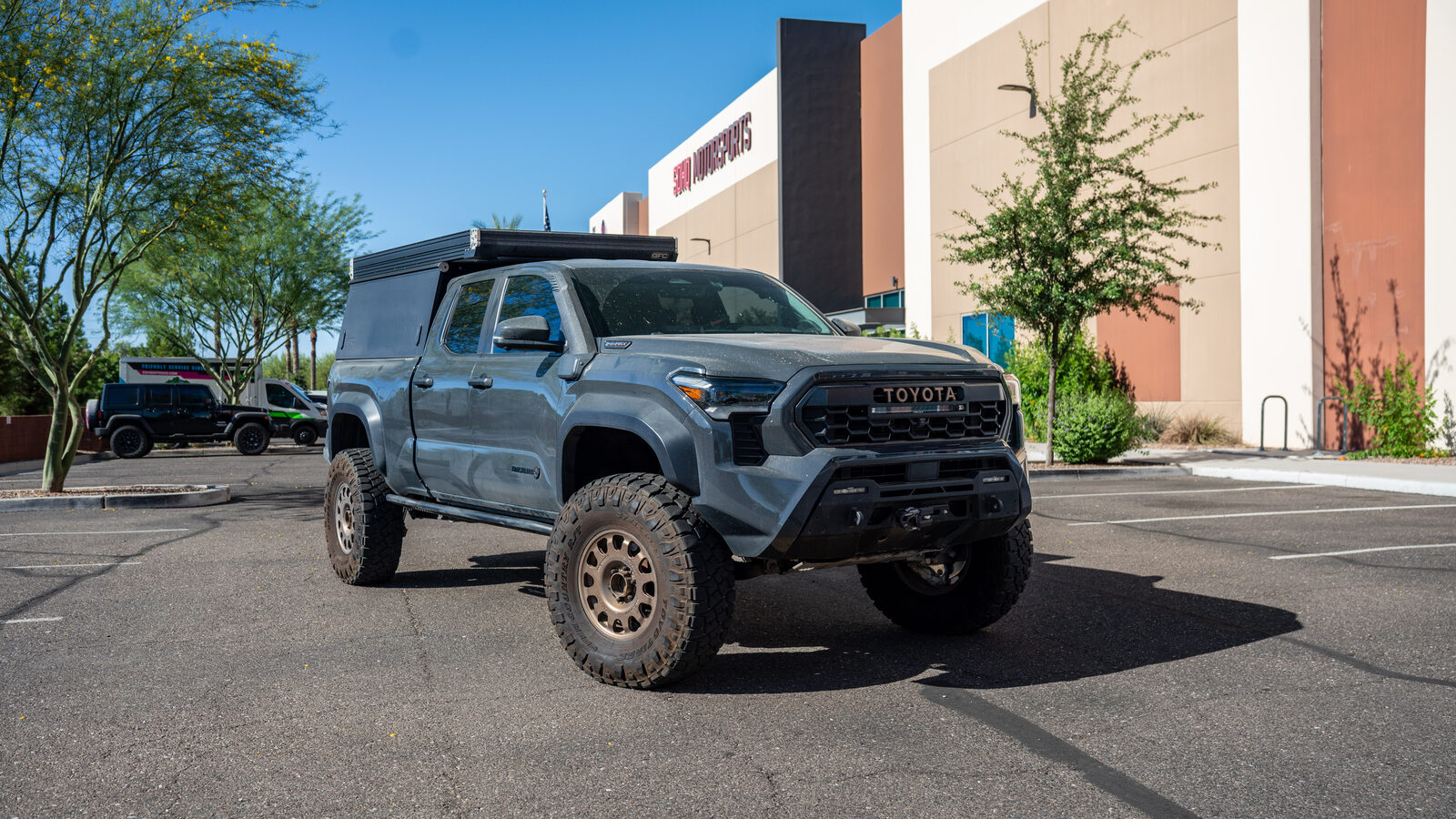
If you are running a 2024+ Tacoma, 4Runner, or Land Cruiser (gas or i-FORCE MAX hybrid) and you want a charge pipe kit that survives heat cycles past the OEM warranty envelope, the Banks 26012 is the only stainless option in the category. $498, no tune, and two things set it apart. Compliance first: couplers left long enough to keep the moving engine from loading the chassis-mounted intercooler, where a rigid short-coupler design feeds that motion straight into the tabs. Then the sizing: a full 3-inch bore on both sides, built for the whole airflow path and ready for the turbo-side parts Banks is developing, where a stepped kit optimizes for stock-truck spool and leaves you re-piping later.
On the competitors, the comparison above holds: aFe for the published flow-and-dyno chart, Mishimoto for price and lifetime warranty, K&N best avoided in California.
Banks publishes the full 2024+ Tacoma lineup on their configurator, including in-development parts like the Monster-Ram Turbo Inlet Elbow (PN 42840), the Intercooler Upgrade (PN 26028), and the Monster Exhaust (PN 48147), so the boost tubes are one decision inside a larger system roadmap.
Buy the 26012 direct from Banks: bankspower.com/products/boost-tube-26012-toyota-tacoma-2-4l. Install reference: Banks owners manual 97768.
Questions about the kit, fitment, or ordering go to Banks directly: bankspower.com/pages/contact-us, phone 800-601-8072, or DM @bankspower on Instagram.