Banks 42291: 18.3 HP Ram-Air Intake for the 4th Gen Tacoma Standard Trims
By Bob Ulrich — videographer and 2024 Tacoma Trailhunter owner behind Portal Hunter
4th Gen Tacoma intakes 101 — new to this? Start here
1 How air actually reaches the turbo
Every 4th gen Tacoma pulls air through a fender inlet, past a paper filter, across the MAF sensor, and into the turbo compressor. Standard trims (SR through Limited) share a narrower tube. TRD Pro uses a larger bore to match its wider performance envelope. Trailhunter adds a factory desert snorkel, which pulls air from the cowl instead of the fender, higher up, cleaner air, no wading risk.
2 Why the turbo cares about this air

A turbo compressor spins past 100,000 RPM, and every spec sheet number depends on three things reaching it: direction, temperature, and filtration. Smooth laminar flow reduces blade loading. Cooler air is denser, so more oxygen per gram. Filtration stops debris from reaching the compressor and turbine wheels, which is the expensive failure mode.
3 What aftermarket intakes actually change

A well-engineered intake improves inlet pressure at highway speeds (ram-air effect), adds filter surface area for longer service intervals, and keeps tube cross-section smooth so flow does not choke before the turbo. A poorly-engineered one trips a CEL or introduces heat soak. Which category a given intake falls into is what the rest of this review unpacks.
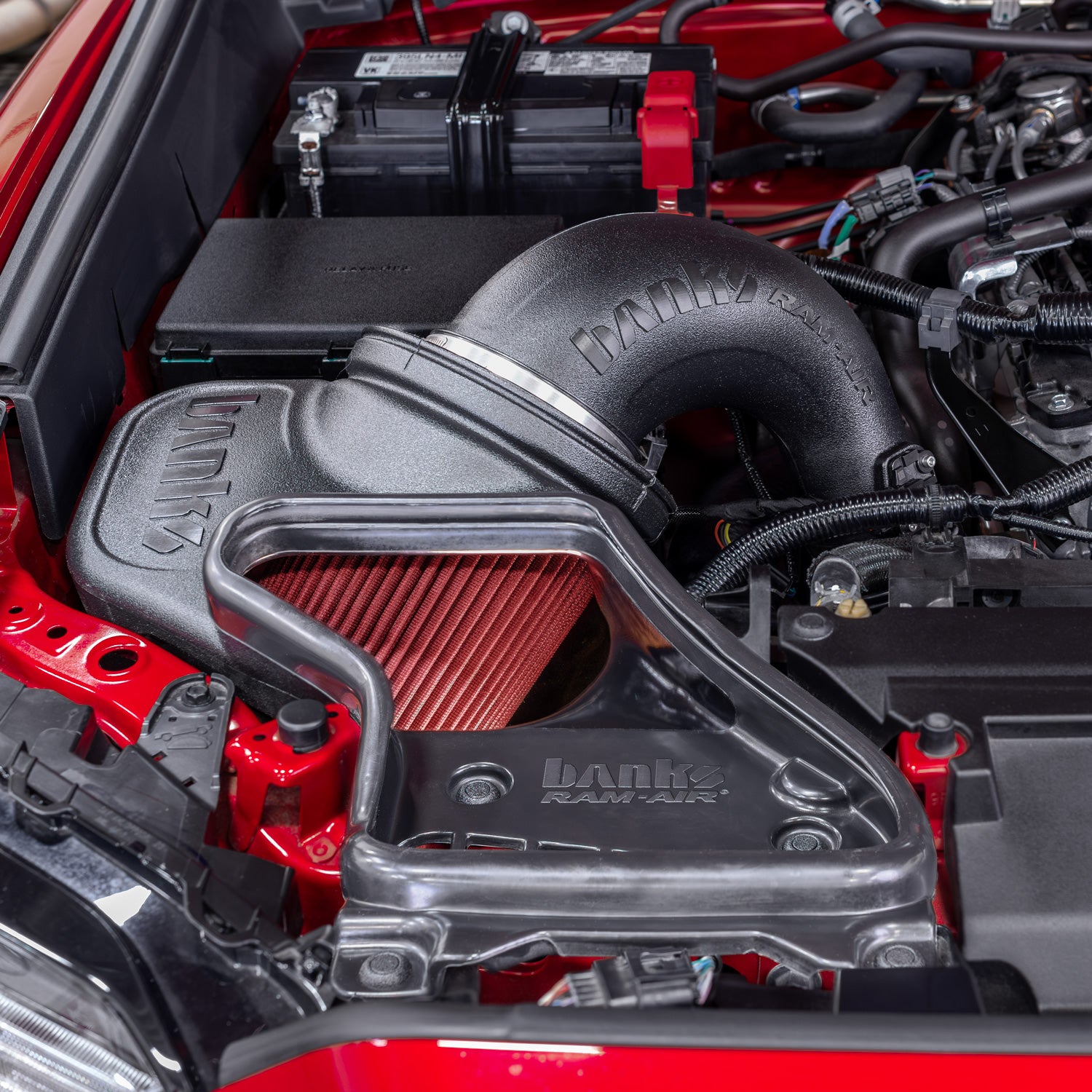
Aftermarket cold air intakes for the 4th gen 2.4L Tacoma and 6th gen 4Runner have a documented check engine light problem. Owners bolting on K&N, aFe Momentum GT, or Stillen TruPower are reporting P0101, P2C90, engine-power-reduced faults, and limp-mode events, and the root causes come down to two specific engineering decisions that some brands didn’t get right for this platform.
Banks Power is the outlier. The Banks Ram-Air Intake (42291) is the one intake in this segment listed with “No Check Engine Light” as an explicit product feature, backed by a sensor layout and vacuum routing engineered around the OEM calibration the factory ECU expects. It’s shipping today at $398 and fits all standard trims — SR, SR5, TRD Sport, TRD Off-Road, and Limited — in both gas and hybrid configurations, 2024-2026 Tacoma and 2025-2026 4Runner.
This post focuses on the 42291. A separate SKU, the 42292, is in development for Trailhunter and TRD Pro — Banks is still validating the prototype tube geometry for those trims. Part 2 is coming. For now, if you’re on a Trailhunter or TRD Pro, the honest answer is: wait. The two-flavor failure analysis below explains why every other brand on the market is throwing codes on your truck, and why a trim-specific SKU is the only real fix.
Two distinct failure modes are driving the reports across the rest of the field — MAF calibration mismatch and turbo inlet + EVAP vacuum routing. Both land as “check engine light after intake install,” but the fix for each is completely different. The engineering breakdown of both is below. First, the forum evidence:
- K&N 63-series on a 2024 Tacoma (turbo inlet + EVAP flavor): Forum user Ace-ington on a 2024 TRD Sport reports in this Tacoma4G thread that even after K&N shipped warranty replacement parts, the truck still threw a P2C90 code. He noted long-term fuel trims at -12% with the K&N installed vs. 0% on stock, and flagged the vacuum-hose routing as messy. Thread starter Drifte on the same thread: “Where those vacuum hoses all tie together is a mess, and the provided hose too small i.d. to fit on.” That’s a turbo inlet / EVAP routing problem, not a MAF code.
- Stillen TruPower on a 2024 TRD Off-Road (MAF flavor): A Tacoma4G Stillen thread captures one of the harsher reports: “i have a MAF code and have the dry filter as well but no scoop… after 75 miles the truck went through the same code and went into limp mode while i was on the freeway and had to limp 30 miles home.” Overland Tailor Tuning (OTT) acknowledged the issue in the same thread and developed a calibration specifically to resolve it — which is telling, because Stillen marketed the kit as “no tune required.”
Trailhunter and TRD Pro owners face an additional trim-specific problem, because those two trims use a larger intake tube cross-section than the rest. Some brands openly state a tune is required on those trims (SXTH’s own product page, for example, lists Trailhunter and TRD Pro as “Fits, but tuning REQUIRED”), and reports of engine-power-reduced faults on the aFe Momentum GT show up in 4Runner6G threads for those trucks specifically. Part 2 covers fitment and tuning requirements on Trailhunter and TRD Pro alongside the Banks 42292 install.
Banks Power designed around this problem from the start. The engineering decisions behind the “No Check Engine Light” claim are the reason the 42291 stands apart from the field. +18.3 hp and +17.7 lb-ft on the dyno is the headline number. The real story is everything that went into making those gains without tripping the truck’s stock OBD-II monitors.
Two Failure Modes, One Symptom

Flavor 1 — MAF calibration mismatch. Stock MAF calibration is tuned around a specific airflow profile through the factory intake housing. Replace the airbox with an aftermarket design that changes flow laminarity or total mass flow without accounting for sensor placement, and the MAF reading drifts outside the ECU’s expected range. Fuel trims drop outside the ±10% threshold and the ECU flags P0101 (MAF circuit range/performance). Oiled filter contamination on the hot-wire sensor is a separate cause of the same drift and compounds the issue over time.
Flavor 2 — Turbo inlet and EVAP vacuum routing. Some intake kits reroute the crankcase vent and EVAP lines through fittings that don’t seal well at the turbo compressor inlet, triggering P2C90 (turbocharger/boost control) codes that look like a MAF issue but aren’t. The K&N 63-series example below is in this category — the forum user was chasing what looked like fuel trim drift, but the root cause was upstream of the MAF sensor.
Here’s how the major options for the 2024+ 2.4L standard-trim platform compare on reported code types, dyno-verified power, and price:
| Intake | Price | Claimed HP | CEL Reports | No Tune Required | |--------|-------|-----------|-------------|------------------| | Banks Ram-Air 42291 | $398 | +18.3 hp | None reported | ✅ Yes | | aFe Momentum GT | $395 | +15 hp | Engine-power-reduced faults on some trim configurations | Unverified | | K&N 63-9043 | $499 | +15.3 hp | P2C90 (boost control) on 2024 TRD Sport; EVAP/vacuum hose routing issues | ❌ No | | SXTH Element CPLT | $419 | +14 hp | No confirmed reports | ❌ Tune required on Trailhunter / TRD Pro (per SXTH) | | HPS Performance | $399 | +18 hp | No reports found | Unverified | | Mishimoto | ~$399 | Not published | No reports found | Unverified | | Stillen TruPower (w/ scoop) | $530 | +24 hp | MAF codes + limp mode on 2024 TRD Off-Road | ❌ No | | S&B 75-5210 | $379 | Not published (claims 59.7% airflow gain) | No reports found | Unverified | | BMS | $279 | Not published | No reports found | Unverified |
Update, August 2026: S&B has revised the 75-5210 since this post first ran. Their product page now lists fitment for every trim including TRD Pro and Trailhunter, handled by shipping two intake tubes in one kit (AL1523-00 for the larger TRD Pro/Trailhunter cross-section, AL1524-00 for everything else), and claims compatibility with the Trailhunter snorkel. Fitment also extends to the 2025+ 4Runner. S&B publishes ISO 5011 flow-bench numbers rather than dyno horsepower, the listing carries zero customer reviews as of this update, and the kit is not 50-state street legal, so S&B blocks shipments to California. Owner installs on TRD Pro or Trailhunter remain undocumented on the forums either way.
Two things stand out. First, Banks lists “No Check Engine Light” as an explicit claim on the product page. That’s not a claim competitors are making in writing, and on a platform where MAF calibration mismatches are documented on Tacoma4G and acknowledged by tuning shops on 4Runner6G, it’s a claim Banks is willing to defend publicly.
Second, Banks ships a trim-specific SKU pair rather than a single universal housing. The 42291 fits standard trims (all Tacoma gas and hybrid trims that share the standard MAF calibration), and a separate 42292 is in development for TRD Pro and Trailhunter. Other brands ship one housing and either don’t fit the higher trims at all or require a tune to patch around the ECU behavior. Part 2 covers the 42292 and TRD Pro / Trailhunter fitment in full.
The Ram-Air Scoop Is Where Most Intakes Leak Hot Air
The scoop is the piece that seals the intake housing against the underside of the hood. If it doesn’t seal cleanly, hot air from the engine bay bypasses the filter and enters the housing directly — which defeats the “cold air” part of “cold air intake.” Banks flagged the scoop construction as one of the biggest points of difference between brands, and the materials side-by-side make the case.
Banks uses an injection-molded silicone scoop. It’s form-fitting to the bottom of the hood and positively seals against it, blocking engine-bay air from entering the housing.
SXTH uses a rubber molding of the type typically found in door trim — functional but not engineered for positive sealing against a hood surface.
Mishimoto uses square foam with double-stick tape. Per Banks’ own teardown, the foam was already peeling off the scoop when they opened the box. That’s a QC-level concern before you even get to the engineering question.
K&N takes the most unusual approach: the housing re-uses the factory “sink trap” inlet from the OEM airbox. Air has to navigate a 90° open entry, then a 180° turn to enter the housing from below. Why design a new intake housing only to use the factory inlet as the air source is a fair question. Separately, the top of the K&N housing is foam rather than a sealed rigid lid, which means hot engine-bay air can enter from above. By the functional definition of a cold air intake — a sealed enclosure that isolates the filter from engine-bay heat — the K&N 63-series doesn’t qualify.
Stillen (with scoop) adds a dedicated scoop to a shared housing design, but MAF code reports on standard trims (including the 2024 TRD Off-Road limp-mode case on Tacoma4G) suggest the sealing is only part of the story.
Video: How Banks Built the Intake
Banks’ current overview video for the Ram-Air Intake is below. A full “Banks vs. Everyone” competitive testing video is a few weeks out, which will include head-to-head data against the major competitors on one instrumented dyno.
The Engineering Behind the Numbers
Banks published specific performance claims that go deeper than “more horsepower.” The four numbers worth paying attention to:
- 45% lower pressure loss vs. stock. Measured at peak MAF demand. This directly reduces turbo workload.
- +8 lb/min MAF gain. More air mass flowing into the turbo inlet for the same throttle input.
- 72% larger Ram-Air duct compared to the OEM inlet duct.
- 37% greater flow than stock across the usable RPM range.

Pressure loss reduction is the headline number. Lower inlet restriction means the turbo compressor wheel doesn’t have to pull as hard to generate the same boost pressure, which translates to lower turbo shaft speeds at a given power output. That’s the counterintuitive part: this intake makes more power AND reduces turbo wear because the compressor is working less to produce it.

The Ram-Air Effect
Calling it “Ram-Air” isn’t marketing flourish, because the name refers to a measurable thermodynamic effect. As vehicle speed increases, ambient air slams into the intake duct at 60+ mph, which raises the static pressure inside the housing. Higher inlet pressure means denser intake charge, which means the turbo sees more air mass without having to compress it as hard.
Banks claims this lets the turbo hit the same boost pressure at lower shaft speeds on the highway than it would with a stock intake. Two practical benefits follow: sharper throttle response because the turbo is already primed, and longer turbo life because it’s spinning slower for equivalent output.
NASA-Inspired Duct Geometry
Banks calls out “NASA-inspired low pressure loss duct bend” on the intake tube, which is a specific reference to NACA duct design principles used in aviation inlet geometry. The practical result is that the tube maintains a full 78.54 square-inch cross-sectional area from the filter outlet all the way to the turbo inlet. Most competitor intakes neck down at the tube outlet, which chokes flow back to near-stock levels despite the larger filter.
Here’s Banks’ side-by-side of the same intake tube section across Stock, Banks, K&N, Mishimoto, and SXTH:

Credit: Banks Power — direct comparison photo provided by Banks.
What to look for in that photo: Stock has an accordion-style flex section that disrupts laminar flow. Banks has a large-diameter, gradual compound bend with the MAF boss molded in. K&N uses a sharp, small-radius bend that forces the airstream to change direction abruptly. Mishimoto uses silicone with internal ribs and external clamps that create step transitions between sections. SXTH narrows toward the outlet and uses a steeper bend angle.
Sharp 90-degree bends cause boundary layer separation, where air near the tube wall slows down and detaches from the surface. That creates recirculation zones that effectively shrink the usable flow diameter. Banks’ tube uses gradual compound bends instead, which preserves the velocity of the air column and keeps the effective flow area close to the geometric area.
Filter Surface Area
Surface area is where Banks’ filter pulls ahead of most competitors. More pleats mean the filter can load up with more dust before airflow starts to restrict, which extends service intervals. Banks offers the filter element as a standalone replacement ($109 MSRP, $121.11 list) and also sells a pre-filter sock ($44.08) for dusty-environment use.

It’s an oiled filter, which raises a common question: oiled filters on turbocharged engines sometimes get blamed for MAF sensor contamination. K&N’s oiled cotton-gauze design has been specifically implicated in P0101 codes on multiple platforms when oil transfers to the MAF hot-wire sensor. Banks’ answer is sensor relocation (more on that below) plus a filter formulation and pre-oiling spec that’s tuned to minimize transfer. Forum reviews from verified buyers on the Banks product page consistently report no CEL issues, including on 4Runner and Tacoma applications across multiple trim levels.
Why It Doesn’t Trip a CEL
This is the part worth understanding in detail because it’s the biggest engineering differentiator between Banks and most other intakes on the 2.4L platform. Banks’ design addresses both of the failure modes described above — MAF calibration drift AND turbo inlet / EVAP vacuum routing.
On the MAF side. Stock MAF calibration on modern turbo engines is tuned around a specific airflow profile through the factory intake housing. The ECU knows what mass of air to expect at a given MAF voltage, and the long-term fuel trims adjust the fuel map to keep the air-fuel ratio in range. Swap the housing with a more open aftermarket design and two things happen at once: the MAF sees a different flow profile (often non-laminar, often turbulent), and the total mass of air moving past the sensor increases. Stock calibration can’t account for either shift, so fuel trims drift outside the ±10% threshold and the ECU flags a P0101 code. Banks’ fix has two parts: the MAF sensor is relocated from inside the airbox (where turbulence from the filter pleats hits it) to the bottom of the intake tube where airflow is smoother, and the housing volume plus tube geometry are engineered to keep the MAF reading profile within the factory ECU’s expected range even with the 8 lb/min of additional mass flow.
On the turbo inlet and EVAP side. Banks’ kit preserves the factory vacuum routing topology rather than introducing new adapter fittings at the turbo compressor inlet. The Monster-Ram turbo inlet (sold separately as part #42840) is the Banks solution for upgrading that part of the charge path deliberately, in a validated way. The Ram-Air Intake by itself doesn’t disturb the crankcase vent or EVAP connections that some competitor kits reroute — which is why forum reports on Banks don’t include the P2C90 boost-control code that shows up on K&N installs.
Fuel trims stay within spec, the ECU stays happy, and the check engine light stays off. No tune is required, no MAF scaling, no calibration reflash is needed for stock ECUs running the Banks intake out of the box.
Fitment
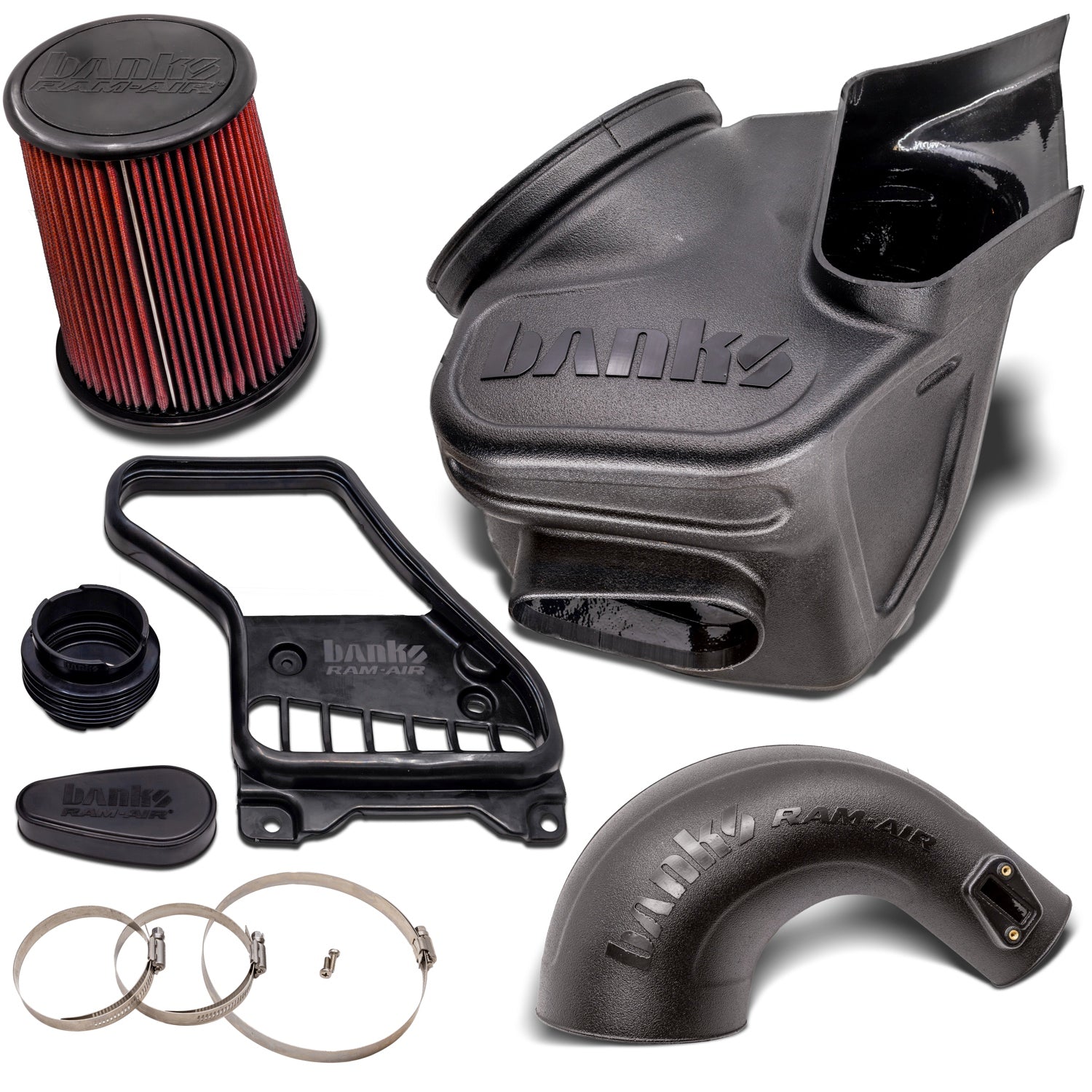
Part #42291 fits 2024-2026 Tacoma 2.4L (Gas and Hybrid) and 2025-2026 4Runner 2.4L (Gas and Hybrid) on standard trims: SR, SR5, TRD Sport, TRD Off-Road, and Limited. $398 sale price ($442.22 MSRP). CARB EO certified (D-161-172) for 2024-2025, 2026 EO pending. 50-state legal in stock configuration. Shipping today.
This part is explicitly listed as not compatible with Trailhunter and TRD Pro — and that’s intentional. Banks is developing a separate SKU (42292) engineered around the larger intake tube cross-section those trims use. See the Part 2 teaser below for what’s coming on that front.
Coming in Part 2: The Banks 42292 for Trailhunter and TRD Pro
If you’re on a Trailhunter or TRD Pro, everything in the “Two Failure Modes” section above explains why your trim is uniquely hostile to aftermarket intakes designed around the standard-trim tube. Toyota built those two trucks with a larger intake tube cross-sectional area at the MAF sensor, and the ECU is calibrated for that geometry. Drop in an intake built for the smaller-area tube and the ECU falls back to a base map, runs rich, and throws “engine power reduced, go to dealership” the same way the aFe Momentum GT thread on 4Runner6G documents.
Banks is finishing a trim-specific SKU to fix this. The 42292 is engineered around the larger tube cross-section, keeps the factory desert snorkel in the circuit, and includes a patented “Slipper Fit” design that accommodates the filter and engine movement those trims see off-road. It claims the same +18.3 hp / +17.7 lb-ft gain as the 42291 — without a tune, without MAF scaling, without a check engine light.
Prototype tube arrives within two weeks per Banks. I’ll install it on my Trailhunter, log iDash data through real overland use, and publish Part 2 with the full install walkthrough, ambient-corrected dyno, LT fuel trim and MAF response under load, heat-soak behavior in desert conditions, and an honest verdict. For now, if you’re on a Trailhunter or TRD Pro, the recommendation is to wait for the 42292 rather than chasing a CEL with any of the other kits on the market.
Banks’ 42292 product page: bankspower.com/products/ram-air-intake-system-42292. Sign up for the “Notify me when available” list there to get the shipping alert direct from Banks.
The Forthcoming Banks vs. Everyone Video
Banks is a few weeks out from releasing a full competitive video, and has stated that they “purchased and tested every competitive intake system” for the platform. The methodology they’ve shown on their Tacoma4G intercooler testing thread is OE-level: every charge-path component instrumented with pressure and temperature sensors, turbo speed sensor, ambient conditions monitored via AirMouse, airflow measured at the filter face via anemometer, and 25-samples-per-second datalogging through the iDash Data Pro.
If that same methodology carries into the intake comparison video, it will be the first head-to-head intake test on this platform with controlled-variable data rather than independent dyno claims from each brand. Most brands currently publish their own numbers on their own dyno under their own conditions. Banks testing competitor intakes on the same instrumented truck under the same conditions is how you get an apples-to-apples comparison.
More data will be revealed in that video. Expect pressure drop curves by intake, MAF response profiles, and thermal data showing heat soak under sustained load. Banks has the instrumentation and the methodology to make claims stick.
Build Quality

Banks engineers the entire system as a validated assembly, not a parts kit. Key details:
- Patented air filter housing with optimized volume to prevent housing choke
- Large Ram-Air scoop that seals to the hood for positive pressure capture
- Side inlet with removable splash guard for weather protection
- Fully enclosed housing to block engine bay heat from reaching the filter
- All hardware and bracketry fabricated to Banks’ OE-supply standards
Banks also sells a Boost Tube Upgrade Kit (part #26012, $498) designed to stack with the Ram-Air Intake for the next airflow restriction downstream. Combined as a bundle, the intake + boost tubes becomes the first half of what Banks is building toward: a complete bolt-on system covering intake, charge piping, intercooler (in development), and cat-back exhaust.
What Could Be Better
Public dyno chart needs more context. Banks publishes +18.3 hp / +17.7 lb-ft as the delta but doesn’t specify ambient conditions (temperature, altitude, humidity) or fuel grade used in the baseline. Pulls were presumably SAE-corrected, but the correction standard isn’t listed. The forthcoming competitive video should address this with full test parameter disclosure.
Oiled filter maintenance. Oiled filters need periodic cleaning and re-oiling, which some owners prefer to avoid. Banks sells the filter element as a replacement rather than a dry equivalent. For owners who want dry-media convenience, the pre-filter sock (add-on) reduces main filter contamination and extends service intervals, but the core filter is still oiled.
Pricing is mid-pack, not budget. At $398, Banks is competitive with aFe ($395) and HPS ($399), but BMS ($279) and S&B ($379) undercut it. The Banks value argument is the 18.3 hp gain plus the sensor compatibility, not the sticker price. If cost is the primary driver, cheaper options exist (with the CEL risk that implies).
Bottom Line
If you’re on a standard-trim 4th gen Tacoma (SR, SR5, TRD Sport, TRD Off-Road, Limited) in gas or hybrid, or a 6th gen 4Runner 2.4L, the Banks 42291 is the only cold air intake in this segment that lists “No Check Engine Light” as an explicit product claim — and the engineering breakdown above shows why that claim holds up. +18.3 hp and +17.7 lb-ft at $398 is competitive pricing for the category; the real value is a bolt-on that doesn’t require a tune to stay within OBD-II spec. For owners already running a COBB Accessport with CAMTuning, the Banks intake drops in alongside without MAF scaling headaches.
If you’re on a Trailhunter or TRD Pro, wait for Part 2. The 42292 prototype is expected within two weeks. I’ll publish the hands-on install, iDash data, and verdict as soon as Banks ships it.
When Banks’ forthcoming head-to-head competitive video drops — previewed on their Tacoma4G intercooler testing thread — it should close the remaining data gaps with controlled-variable testing against the competitive field on one instrumented truck. Until then, the existing engineering data, CARB EO certification, and No-CEL product claim are enough to put Banks ahead of the field on the three factors buyers actually weigh: power, compatibility, and no trouble codes.
Buy the 42291 direct from Banks (code PORTALHUNTER for 10% off): bankspower.com/products/ram-air-intake-system-42291. For product questions or fitment confirmation, reach Banks via their contact page or by phone at 800-601-8072.
Questions about the intake, fitment, or ordering go to Banks directly: bankspower.com/pages/contact-us, phone 800-601-8072, or DM @bankspower on Instagram.