The Most Innovative Light Bar From a Company You've Likely Never Heard Of
By Bob Ulrich — 2024 Tacoma Trailhunter owner, Triple-R R&D test vehicle
4th Gen Tacoma CAN bus 101 — new to this? Start here
1 What CAN bus does on a 4th gen Tacoma
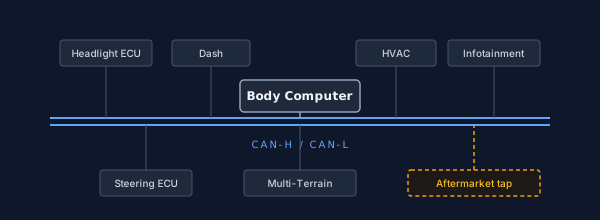
Every module on a modern Tacoma talks to every other module through one shared network called CAN bus. Headlights, dash, infotainment, HVAC, steering controls, all of it rides the same two wires. Swap in an aftermarket accessory that speaks CAN politely, and everything stays happy. Swap in one that does not, and you get warning lights, no-starts, or bricked modules.
2 What a 'drop-in' accessory actually taps into
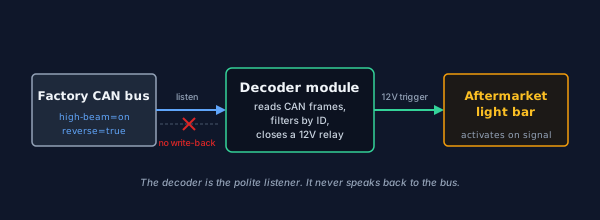
A drop-in lighting kit or auxiliary-power kit usually does not join CAN bus as a peer. It listens to specific factory messages like high-beam on, reverse gear, ignition state, and acts on them. A decoder module does the translation. When vendors skip the decoder and splice straight into lighting outputs, modern Toyotas notice and throw warnings.
3 On a Trailhunter, the bus is more crowded
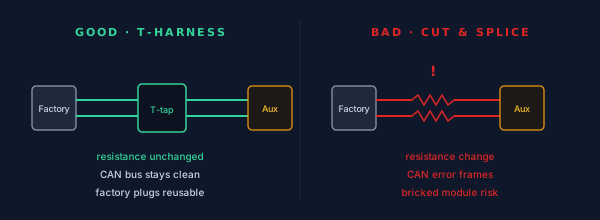
Higher trims ship with more modules on CAN bus than a base truck. A Trailhunter has extra off-road lighting circuits, factory bed scene lights, and the multi-terrain system. More modules means more surfaces where a bad tap-in can trigger a fault. A T-harness passthrough is the safe play. Cut-and-splice is where stories about bricked modules come from.
If you own a 2024+ Tacoma TRD Pro or Trailhunter, the factory grille light bar already does something most aftermarket options can’t: it turns on automatically when you flip your high beams. Pull the stalk and the bar lights up with your brights, with no extra switch on the dash and nothing to toggle by hand.
Swap it for any aftermarket grille bar on the market and you lose that. Every other drop-in kit for this truck (Rave, Heretic, Baja Designs, Diode Dynamics) ships with a standalone wiring harness, a relay, and a separate cab switch. You have to route wire through the firewall, mount a switch somewhere on the dash, and reach for it every time you want more light. Forum threads on Tacoma4G and TacomaWorld are full of owners working through exactly this problem.
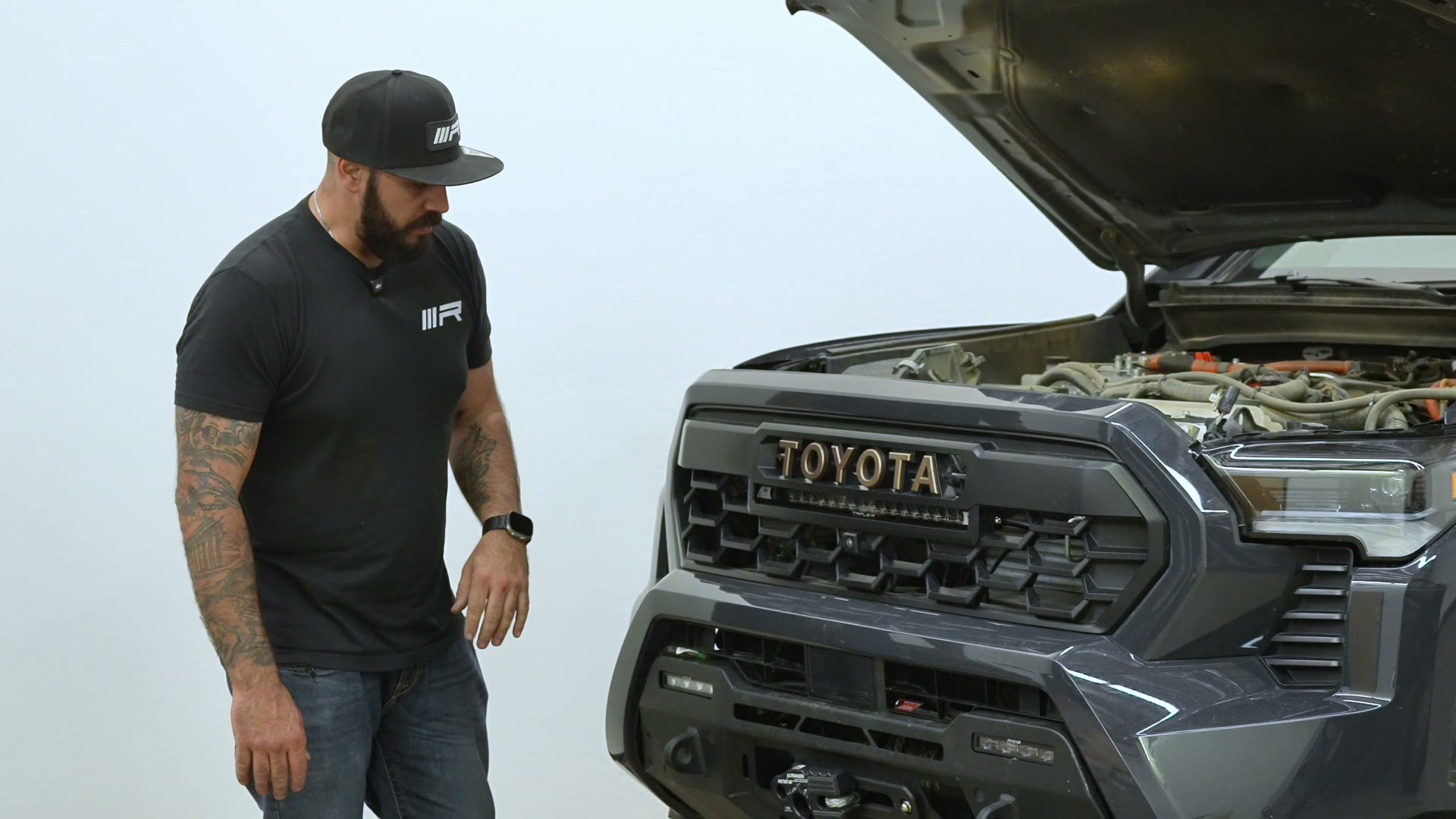
Triple-R’s Linear-18 Elite+ grille kit paired with the CANNY Interface is the only aftermarket option I’ve found that keeps the factory behavior. CANNY is an extra-cost module (not plug-and-play, more on that below), but once it’s mounted and wired, the bar triggers with your high beams exactly like the OEM one does. No new switch on your dash, no reaching for anything in the cab, no thinking about it after install day. Triple-R reached out about using my Trailhunter as a test vehicle for R&D on this kit, and the photo above is now their official launch shot for the TRD Pro and Trailhunter grille kit. Triple-R lists the kit as “compatible with Toyota Tacoma Trailhunter 2024” alongside TRD Pro on the product page itself.
A Quick Word on Triple-R
Triple-R is the US arm of Lazer Lamps, a UK lighting outfit headquartered in Harlow, Essex. Lazer was founded in 2010 by Ben Russell-Smith, who had previously run exterior lighting projects at Nissan’s European Technical Centre and Ford of Europe before going independent. Design and assembly still happen at the UK facility with end-to-end traceability: components, photometric testing, and leak testing all in-house.
Their first full year of production they picked up a “Most Innovative New Motorsport Product 2012” nomination, and the racing pedigree compounded from there. Over 30 vehicles ran Lazer-built lights at the most recent Dakar Rally including Toyota Gazoo Racing’s Hilux T1+, the same lamps survive King of the Hammers, and trophy-truck teams across Baja and the African rally circuit run them. They don’t operate a US dealer network and barely advertise stateside, which is why your Tacoma forum’s “best aftermarket light” thread has probably never named them. The Linear-18 Elite+ in this review uses the same optics and electronics platform as those rally lamps, repackaged with grille brackets for a 2024+ Tacoma.
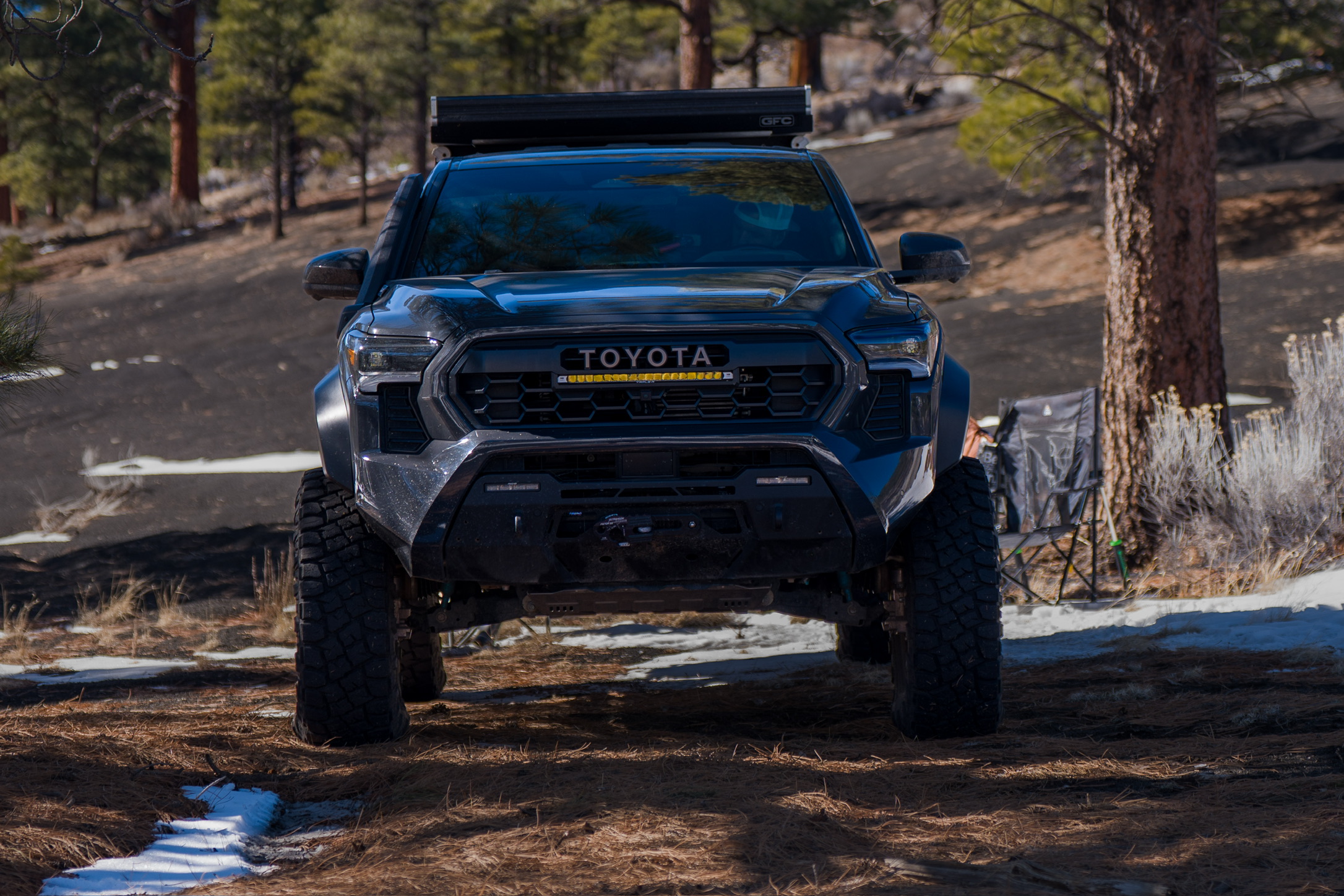
Only One Kit Triggers With Your High Beams
Five brands make a drop-in grille bar for the 2024+ Tacoma TRD Pro and Trailhunter. Scan the Auto High-Beam Trigger column before anything else. That’s whether the bar turns on by itself when you pull the stalk, or whether you have to mount a switch in the cab and reach for it every time.
| Kit | Kit Price | Lumens | Auto High-Beam Trigger | Switchable Dual-Color | Warranty |
|---|---|---|---|---|---|
| Rave Off Road 20” | $249 | 8,000 | No (cab switch) | No (Clear or Amber at purchase) | 2-year |
| Diode Dynamics SS20 Pro Kit | $499.95 – $649.95 | 7,376 (Sport) / 25,088 (Pro) | No (cab switch) | No (White or Yellow + amber backlight) | Limited Lifetime |
| Heretic 6 Series 20” Kit | $715 | 14,520 | No (cab switch) | No (Clear or Amber at purchase) | Limited Lifetime |
| Triple-R Linear-18 Elite+ Grille Kit | $825 (+$195-$245 for CANNY) | 14,850 / 21,000 | Yes, via CANNY add-on | Yes (White + Yellow, toggle) | 5-year + lifetime lens |
| Baja Designs S8/S2 Pro Kit | $970 | ~10,814 | No (cab switch) | No (amber backlight add-on) | Limited Lifetime |
One important clarification: $825 covers the lamp, harness, brackets, and filler plates that cover the top of the camera housing. Run it that way and you activate the bar from a factory AUX switch or a Switch Pro panel like any other kit. Automatic high-beam triggering requires the CANNY Interface module at checkout, which adds $195 (Direct Connect) or $245 (Contactless). Full auto-trigger path lands at $1,020 to $1,070 depending on which CANNY you pick.
Rave Off Road is the budget entry at $249: solid for the price, but at 8,000 lumens and IP67 it’s a different tier. Diode Dynamics offers the widest price spread: Sport at $499.95 puts out 7,376 lumens, Pro at $649.95 jumps to 25,088 lumens on a 105W bar. Heretic and Triple-R are close on white-only lumens (14,520 vs 14,850), with a $110 gap separating the two kits (Heretic $715, Triple-R $825) that buys switchable dual-color output plus the lifetime lens warranty; CANNY is what you add on top for the automatic integration. Baja Designs runs $970 for a three-light configuration (10” bar plus two pods) with dual independent wiring harnesses and a cab switch, and still can’t auto-trigger with the high beams.
Worth noting: Cali Raised LED makes a 32” Lo Pro kit ($385) that mounts behind the lower bumper opening, not the upper heritage grille. Different mounting location entirely, so it’s complementary rather than competitive. You could run a Cali Raised below and a Triple-R above on the same truck.
Every other kit in the table ships with a cab switch and a relay harness you have to mount and wire yourself. On this truck, there’s no easy way to tie an aftermarket bar to your high beams: the signal that tells the factory bar to turn on isn’t a simple 12V wire you can tap. Triple-R solved it with the CANNY Interface module (more on that below), which you add to the grille kit at checkout and install separately. Once it’s in place the bar behaves like the OEM one did, but the CANNY itself is a real install, not a pigtail swap.
Dual-Color Output
Most competing bars make you commit at purchase: Clear lens or Amber lens, pick one. Rave, Heretic, and Diode Dynamics all sell their bars as separate single-color SKUs. Diode’s SS20 and Baja’s S8 add an amber backlight accent, but the main beam is still whatever you ordered. Triple-R built 36 white LEDs and 18 PC-yellow LEDs into the same bar. A momentary switch toggles main-beam color on demand, and a memory function recalls your last selection on startup.
White (5000K) is the primary driving mode. PC-yellow is optimized for dust, fog, and snow, where white light scatters and creates glare. Living in Arizona, the yellow mode has a real use case in the desert where dust plumes from lead vehicles can turn white light into a wall.
Here’s what each mode looks like at night on desert terrain, same location and camera angle:
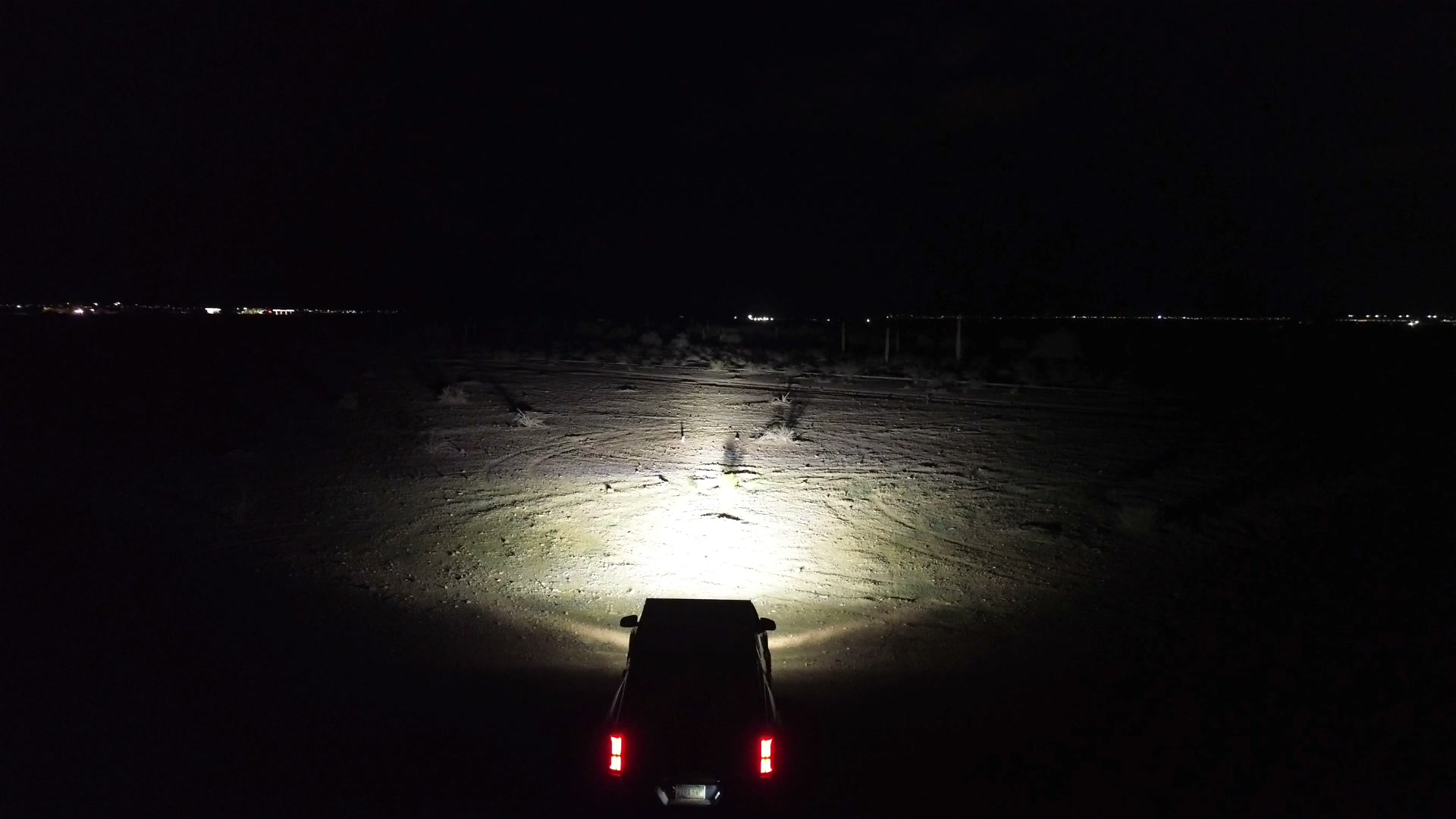
White mode (5000K): full 14,850 lumens, broad beam spread for open desert and trail driving.
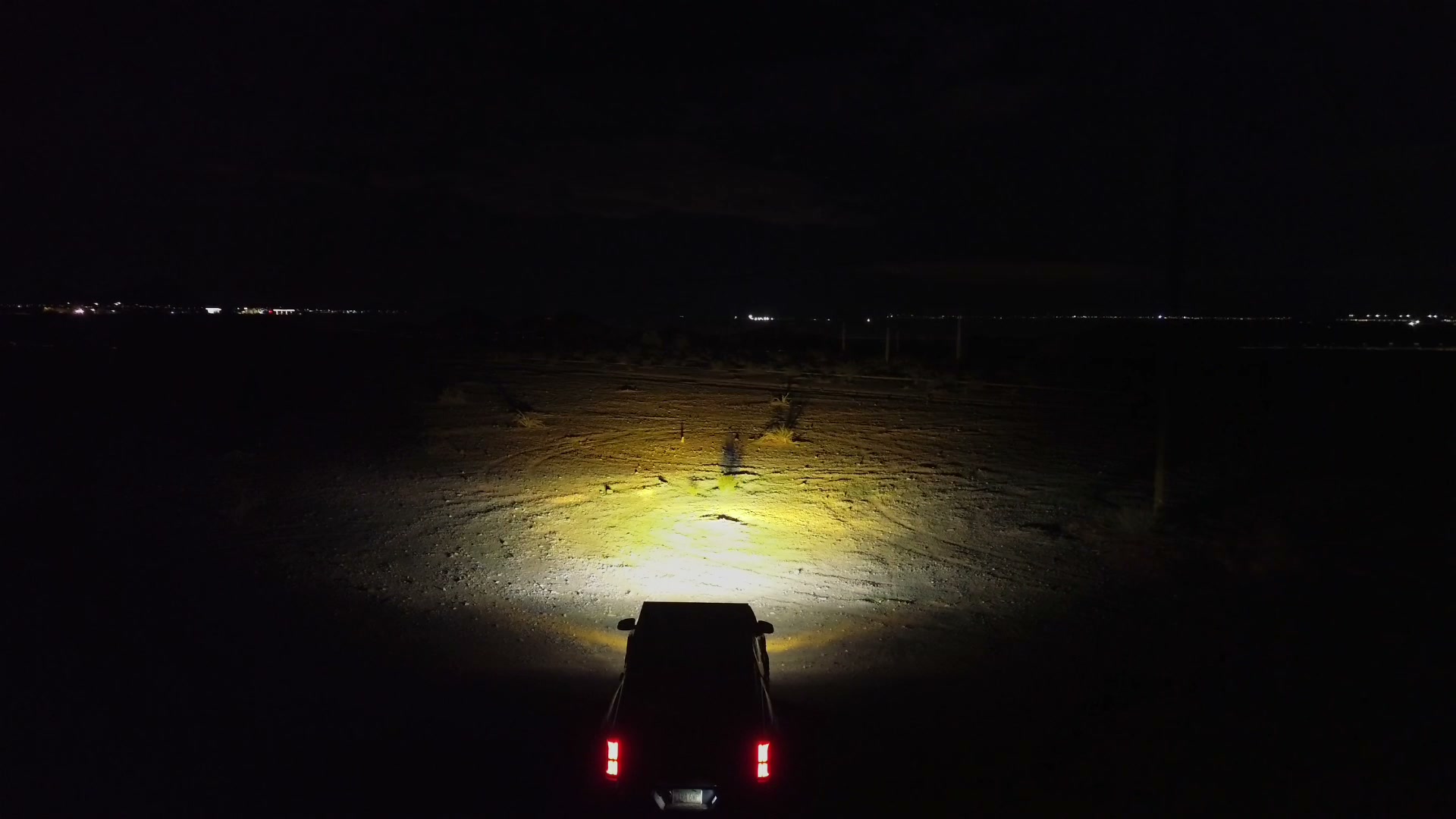
Yellow mode (PC-amber): optimized for dust, fog, and snow. Cuts through particulates without scattering back into your eyes the way white light does.
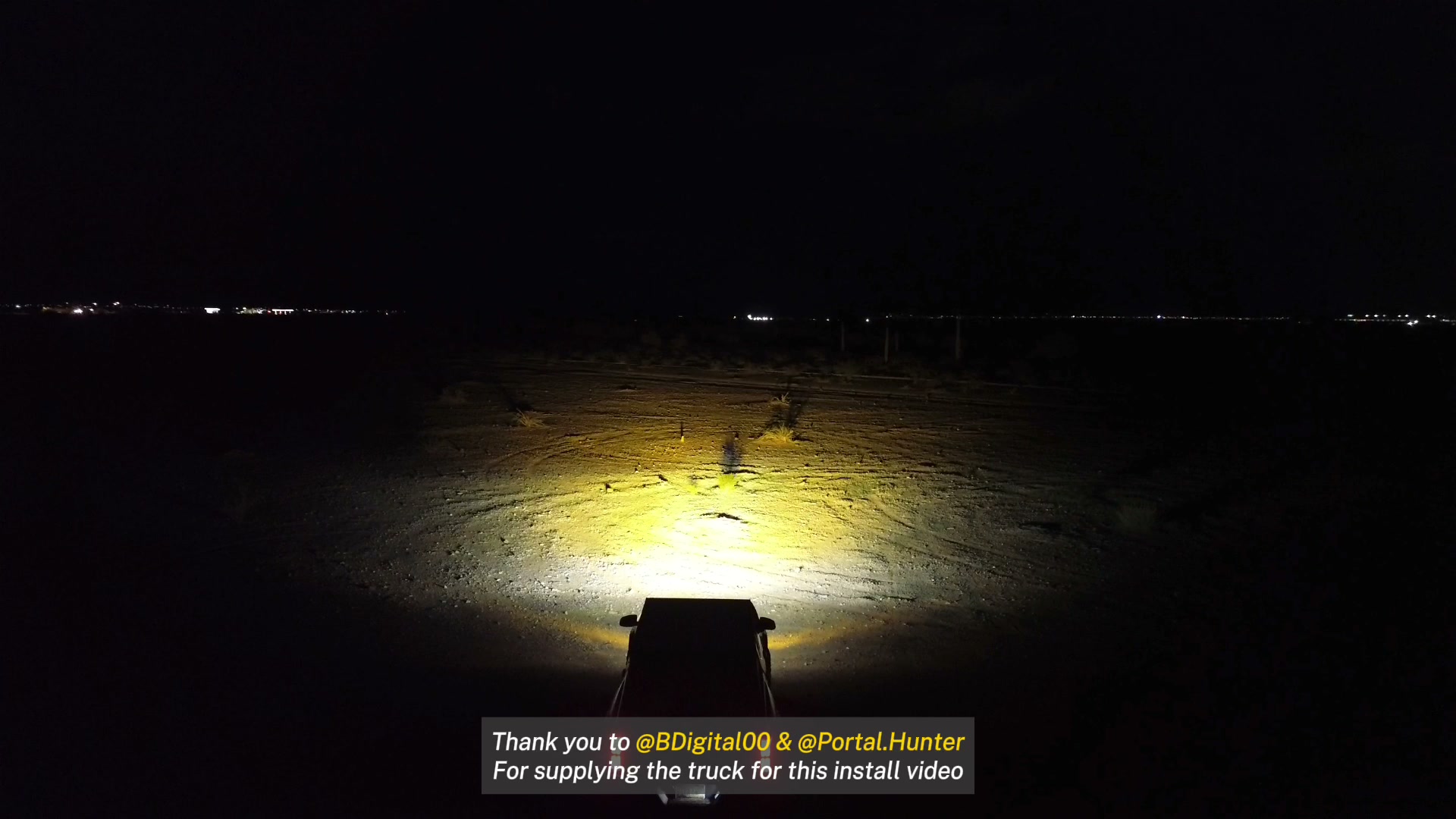
Combo mode: all 54 LEDs active (36 white + 18 yellow) for 21,000 lumens of combined output. Maximum illumination with a warm bias that balances distance throw and peripheral visibility.
Install Walkthrough
Total time was about 45 minutes including breaks to film. Triple-R rates this as a no-drill install with basic hand tools (10mm socket, hacksaw for minor bracket trimming, Allen key for the anti-theft fasteners).
Step 1: Remove the Grille
Pop the hood. Three 10mm bolts hold the grille to the core support. Unplug the fog light connectors and parking sensor harness on each side, then release the retaining clips along the bottom edge. The whole grille assembly slides forward and off.
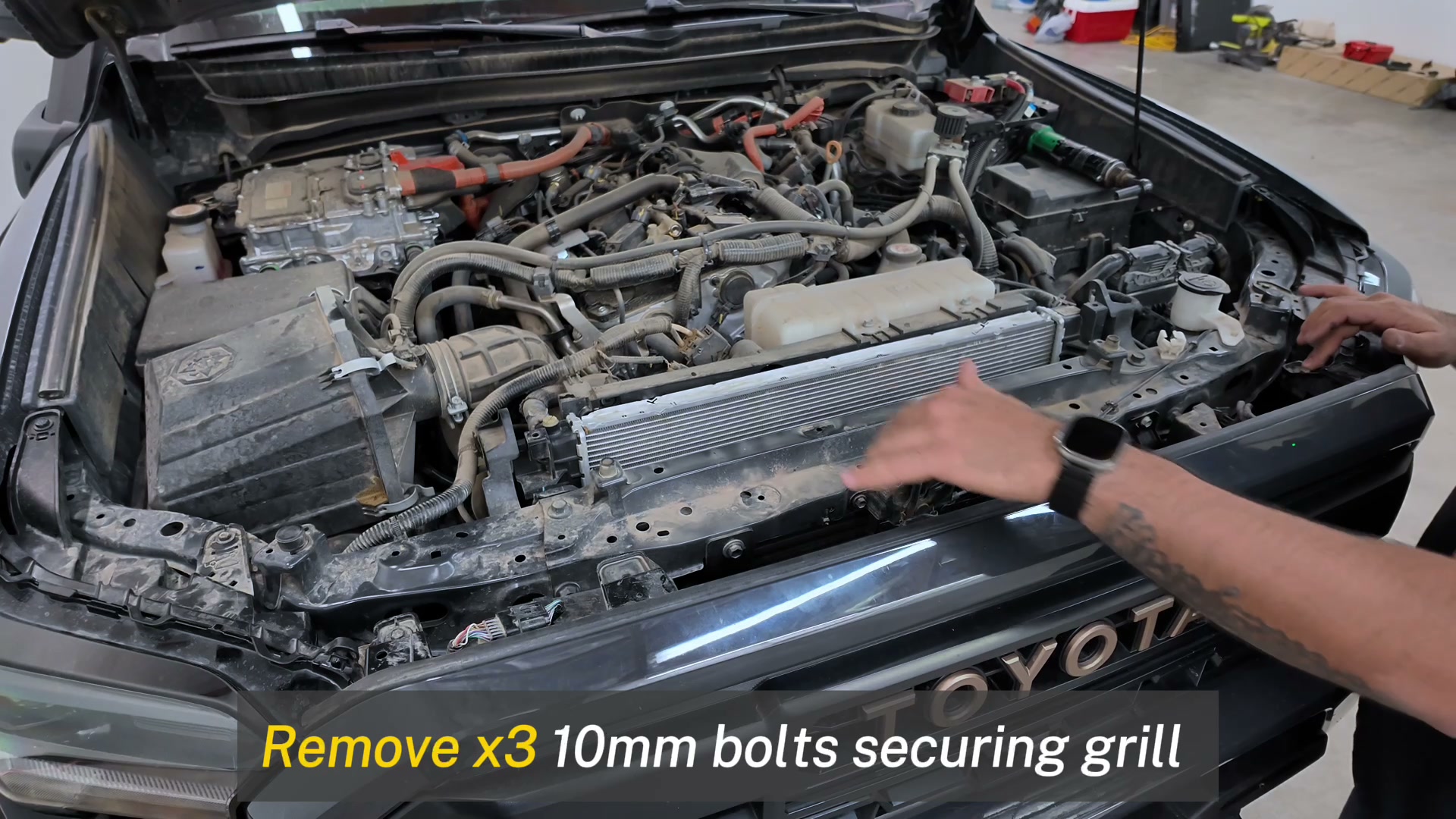
Step 2: Disconnect the Factory Bar
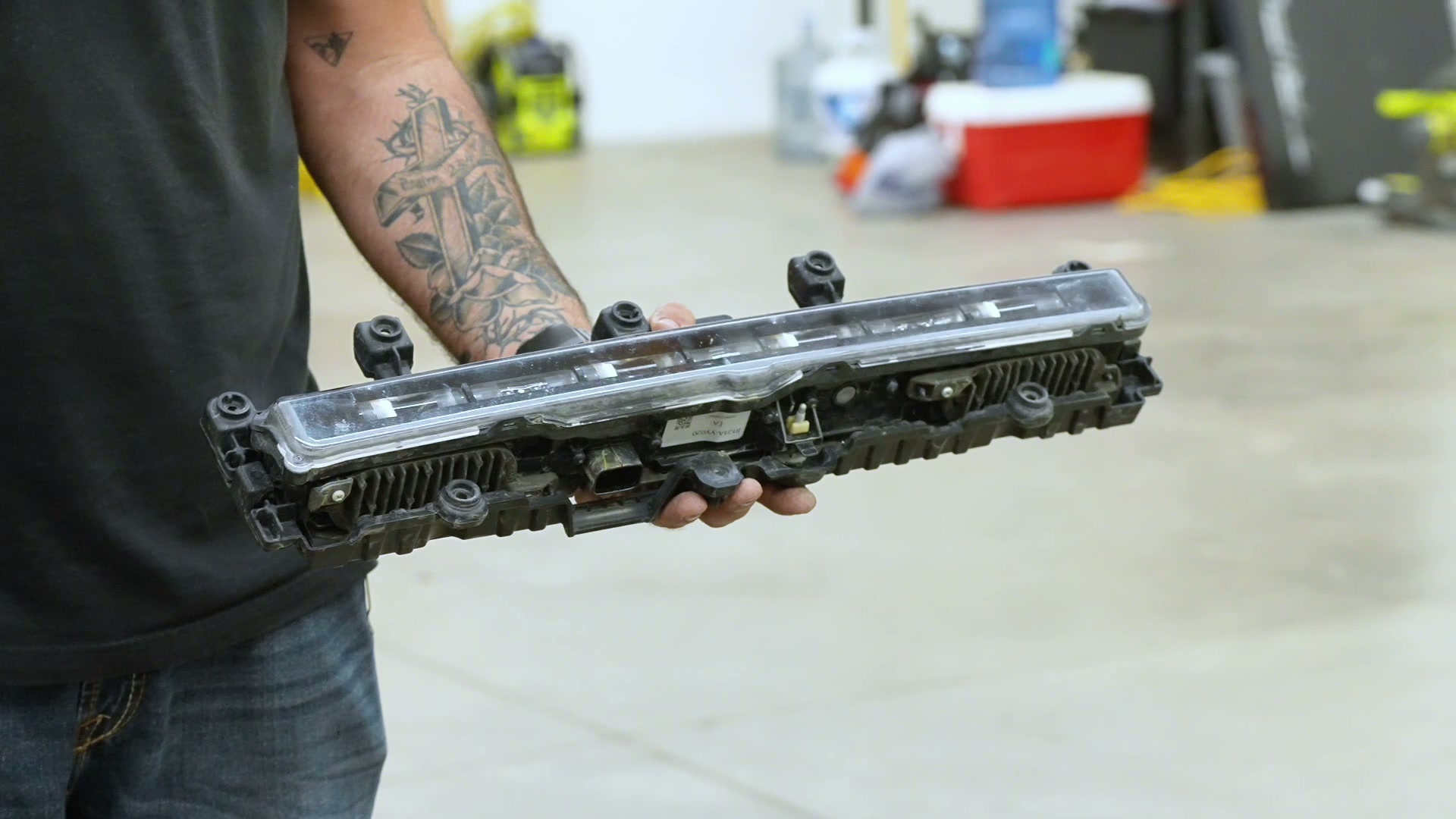
With the grille on a clean surface, unbolt the OEM light bar. Here’s what that factory bar looks like up close. It has its own CAN bus module built in, which is part of the reason aftermarket wiring gets complicated on this platform.
Step 3: Mount the Brackets
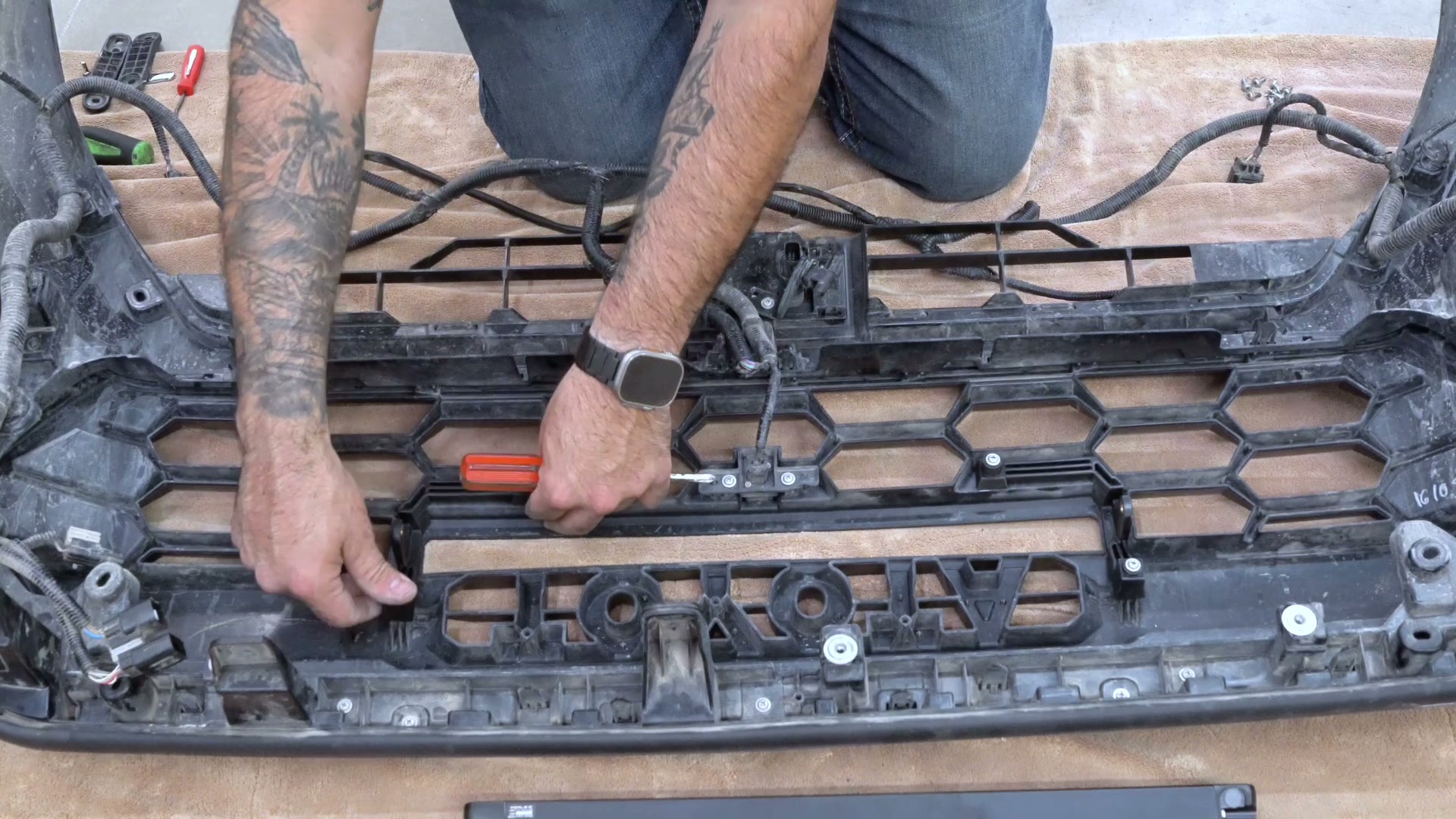
Triple-R ships two composite brackets coded LHOB (left) and RHOB (right). They engage with the factory mounting points on the grille frame. Anti-theft fasteners with a keyed Allen tool secure the bar. Per the install instructions PDF, Triple-R recommends thread seal compound (Loctite 222) and an 8 Nm torque spec to prevent binding over time.
Step 4: Seat the Light Bar
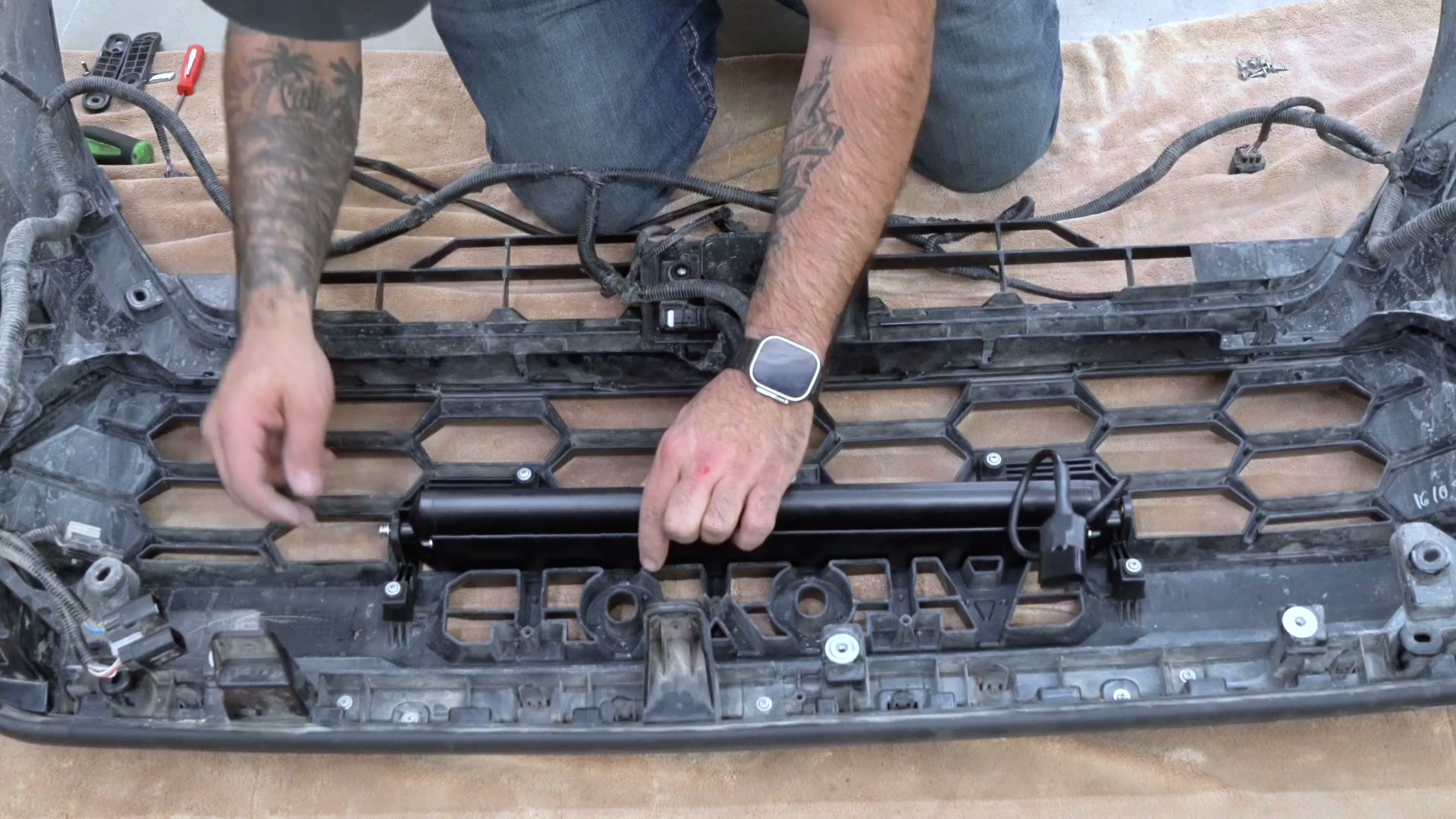
The Linear-18 drops into the brackets. Cover pieces snap over the bracket ends for a clean finished look. At this point the bar is physically installed. Everything from here is electrical.
Step 5: Wiring
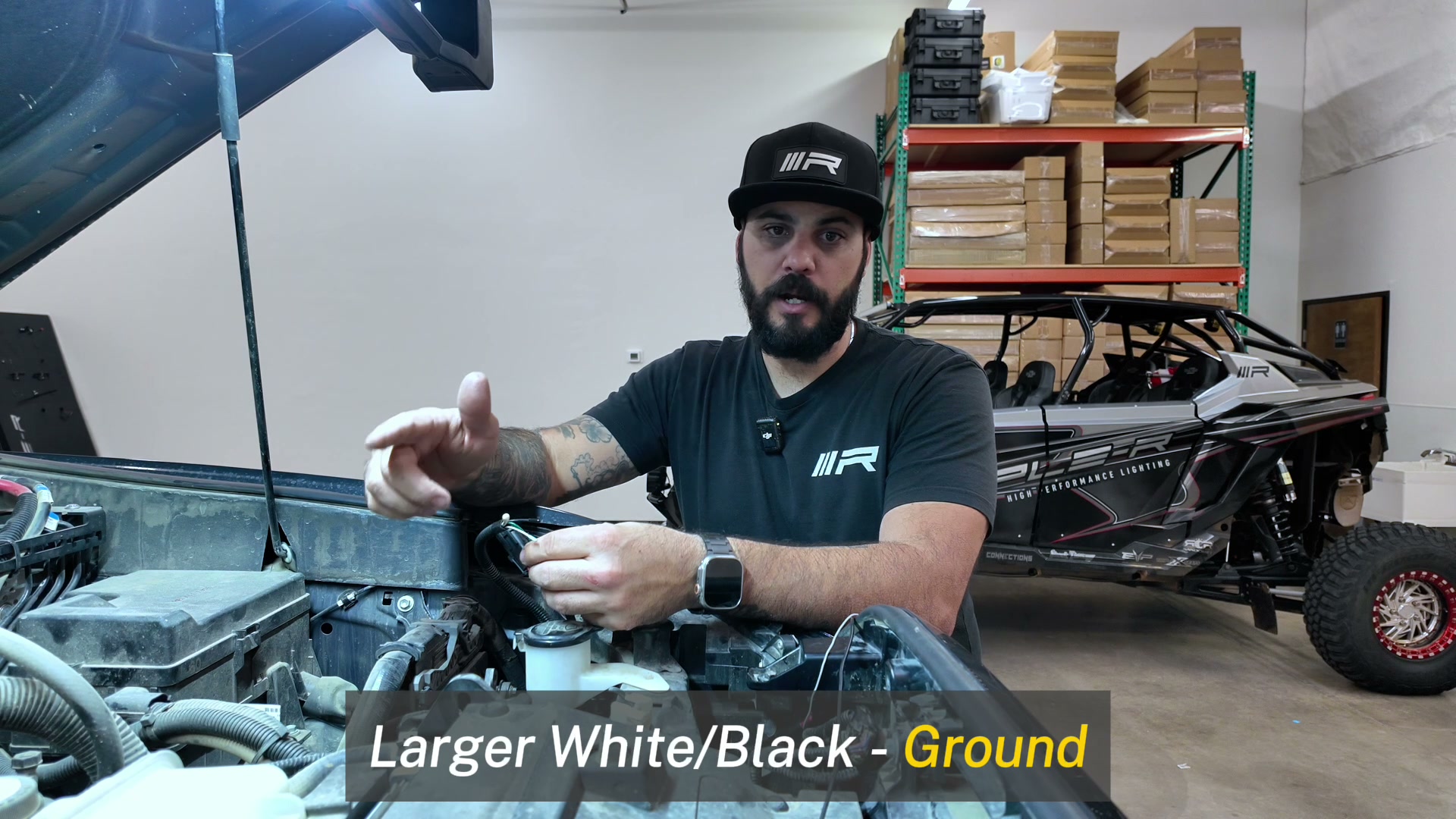
First thing worth knowing before you touch any wire: unplugging the factory OEM light bar does not throw any codes on the 2024+ Tacoma. You can leave it disconnected indefinitely and the truck won’t complain. That gives you room to take your time on the wiring side without worrying about dash warnings.
Triple-R’s grille kit ships with a one-lamp wiring harness, brackets, and filler plates that cover the top of the forward camera housing. You have two paths from here:
Path A: Base kit with a manual switch. Route the harness through the engine bay to an ignition feed and tie the switched leg to a factory AUX switch or a Switch Pro panel if you already run one. No CANNY required. Same workflow as any other aftermarket bar, but with a better lamp.
Path B: Base kit plus CANNY for automatic activation. Same harness, but instead of a cab switch the bar’s trigger leg goes to a CANNY module that reads the truck’s high-beam message off the CAN bus. Once installed, the bar behaves like the factory one did: pull the stalk for high beams and the Triple-R bar comes on at the same instant, without a dashboard switch or any manual toggle to track. Install details for the CANNY itself are in the next section; it is a bigger job than most owners expect.
Step 6: Reinstall the Grille
Reverse of removal. Reconnect the fog lights and parking sensors, align the grille, and reinstall the three 10mm bolts. Verify all clips seat flush along the bottom edge.
How the CANNY Module Makes the High-Beam Trigger Work
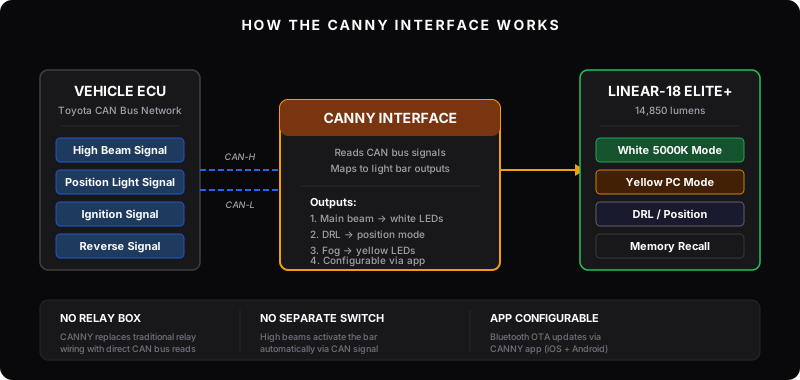
CANNY is a sealed electronic module from Triple-R’s sister brand Lazer Lamps. It’s not bundled with the grille kit. You add it at checkout, mount it physically, and wire it between the truck’s CAN bus and the bar’s trigger leg. Robert at Triple-R said it directly: he would not call this plug-and-play, and he’s right. What is transparent is the end result. Once the CANNY is installed, the driver-seat experience matches the factory bar exactly, with the Triple-R bar coming on the instant you pull the stalk for high beams.
Modern vehicles like the 2024+ Tacoma don’t run a simple 12V wire to things like the headlights anymore. Everything is managed through the CAN bus, a two-wire digital network the ECU uses to talk to every module on the truck. Flip your high beams, and the ECU sends a digital message across that network. Every other aftermarket light bar on the market assumes an old-school analog trigger exists somewhere in the engine bay. On this platform it doesn’t. That’s why competitors ship cab switches: they physically can’t listen to the high-beam signal without a decoder. CANNY is that decoder, and it closes a power circuit to the light bar the instant it hears the right message.
On the 2024+ Tacoma specifically, forum threads on Tacoma4G confirm why CANNY is the only approach that works. Owners who’ve tested the wiring at the headlight assembly find nothing changes when high beams are on, because the signal is digital, not analog.
Direct Connect vs. Contactless
Two SKUs at checkout, same end capability:
| CANNY Version | Price | Connection Method | IP Rating | Mount Location |
|---|---|---|---|---|
| CNY-US-DIR-K (Direct Connect) | $195 | Tap directly into the two CAN bus wires (wires are spliced) | IP68 | Engine bay or cab |
| CNY-US-CC-K (Contactless) | $245 | Slides between the CAN bus wires, zip-tied in place, no cutting of OE wiring | IP64 | Cab preferred |
Direct Connect is the lowest-cost option and the right pick if you’re comfortable splicing factory wires. IP68 makes it safe for engine bay mounting. Contactless costs $50 more and trades a lower IP rating for zero factory-wire modification: you slide the reader between the two CAN bus wires, zip-tie it down, and nothing on the vehicle is cut. If you lease the truck, plan to resell, or just don’t want to touch OE wiring, the $50 premium buys peace of mind.
Either way, CANNY itself is a sealed unit you physically mount and wire. Install time for most owners is under an hour once the grille work is done.
What Else CANNY Can Do
CANNY supports up to four independent 12V trigger outputs, so one module can map multiple vehicle events to multiple lighting behaviors. Common configurations on the 2024+ Tacoma:
- High beam → bar activation (the headline use case)
- Position lights → DRL mode on the bar’s backlight channel (Linear-18 Elite only, not Elite+ - the Elite+ uses that channel for PC-yellow LEDs instead)
- Reverse → rear auxiliary lights on an extra output
- Brake, turn, or hazards → chase or alert lights for trail running and stuck recoveries
- Any 12V trigger you want, including interior camper lights, bed lights, air compressors, and air horns
Configuration and firmware updates happen over Bluetooth through the CANNY app on iOS or Android. All four outputs are remappable on the fly from the app, so you can change behavior without pulling the module out of its mount.
Bluetooth Buttons Eliminate the Cab Switch
Triple-R sells optional wireless Bluetooth buttons that pair with CANNY. Stick one to the dash or steering column with 3M tape, pair it in the app, done. No wire runs through the firewall, no hole drilled into a trim panel. On the Linear-18 Elite+ specifically, a Bluetooth button can drive the momentary color-cycling input, so you toggle white, yellow, and combo modes on the fly without installing any traditional switch.
Between the automatic high-beam trigger for on/off and a Bluetooth button for color cycling, it’s entirely possible to run the Elite+ with CANNY and add zero physical switches to the cab.
Coming in 2026: CANNY HP
Triple-R has a CANNY HP version in development with four 20A supported circuits. That’s the version to watch if you’re running multiple high-draw lights or you want to eliminate the separate relay harnesses most light bars require back to the battery. With the HP version, within the 20A-per-circuit limit, you wire the lamp power directly to CANNY instead of running a relay harness. Not shipping yet as of April 2026, but worth knowing if you’re planning a larger build.
On the Linear-18 ILBA
If you picked the Linear-18 Elite ILBA ($960, Intelligent Low Beam Assist) instead of the Elite+, CANNY configuration gets more involved. ILBA reads steering angle and vehicle speed to modulate beam behavior, so CANNY has to feed it more data than a simple high-beam trigger. Triple-R documents that setup on the product page; I haven’t run ILBA, so I won’t pretend otherwise.
Trim compatibility note: CAN bus exists on every 2024+ Tacoma, from SR to Trailhunter. CANNY reads vehicle-level CAN signals (high beam, ignition, position lights), not trim-specific aux switches, so the CAN bus functionality works across all trim levels. What changes between trims is the grille shape, and Triple-R ships two kits to match: the TRD Pro / Trailhunter heritage grille kit reviewed here, and a TRD Pre-Runner / Sport / Off-Road kit sold separately. SR5 owners are the only group without a dedicated kit and would need universal mounting brackets to run the same Linear-18 bar and CANNY module.
Price Per Lumen
Price is only half the picture; lumens per dollar tells the more useful story. Here’s how every drop-in heritage grille kit compares, sorted by best $/1000 lumens.
| Light Bar Config | Price | Lumens | $/1000 Lumens | CAN Bus Auto-Trigger | Switchable Dual-Color |
|---|---|---|---|---|---|
| Diode Dynamics SS20 Pro Combo | $649.95 | 25,088 | $25.91 | No | No |
| Rave Off Road 20” | $249 | 8,000 | $31.13 | No | No |
| Triple-R Elite+ kit only, combo mode | $825 | 21,000 | $39.29 | No (factory AUX or Switch Pro) | Yes (W + Y) |
| Triple-R Elite+ + CANNY Direct Connect, combo mode | $1,020 | 21,000 | $48.57 | Yes | Yes (W + Y) |
| Heretic 6 Series 20” | $715 | 14,520 | $49.24 | No | No |
| Triple-R Elite+ + CANNY Contactless, combo mode | $1,070 | 21,000 | $50.95 | Yes, no OE wire cuts | Yes (W + Y) |
| Triple-R Elite+ kit only, white only | $825 | 14,850 | $55.56 | No (factory AUX or Switch Pro) | Yes (W + Y) |
| Diode Dynamics SS20 Sport | $499.95 | 7,376 | $67.78 | No | No |
| Baja Designs S8/S2 Pro Kit | $970 | ~10,814 | $89.70 | No | No |
Diode Dynamics’ SS20 Pro Combo leads the table at $25.91 per 1000 lumens, driving 25,088 raw lumens from a 105W bar. Rave Off Road follows at $31.13, though at 8,000 lumens it’s a different output tier entirely. Triple-R occupies the $39-$51 per 1000 lumen band depending on whether you add a CANNY and which version you pick.
One caveat on the Triple-R combo number: it adds 14,850 white + ~6,150 PC-yellow lumens across different spectra, while competitors are white-only. Read $39-$51 per 1000 lumens as total photon output, not equivalent white illumination. White-only kit-only is $55.56 per 1000 lumens, which is the direct apples-to-apples comparison with Heretic ($49.24) and Rave ($31.13).
A separate call-out worth making: Triple-R with CANNY Direct Connect ($48.57 per 1000 lumens) actually undercuts Heretic ($49.24) while adding CAN bus integration, switchable dual-color, mode memory, a programmable trigger module, and a lifetime lens warranty. Baja Designs costs $970 for less total output spread across three separate lights and dual wiring harnesses, and still can’t auto-trigger with the high beams.
Price-per-lumen isn’t the whole story for this platform. None of the four competitor kits integrate with CAN bus at any price, so they can’t auto-activate with high beams without a third-party decoder none of them ship. Adding CANNY to a Triple-R kit keeps the factory automatic behavior and unlocks a handful of configurations competitors don’t offer (DRL backlight, dual-color, Bluetooth buttons, multi-output programming). That’s what you’re buying above the $825 kit price, not raw brightness.
Also worth knowing: Cali Raised LED makes a 32” Lo Pro kit ($385) that mounts behind the lower bumper opening, not the heritage grille. Different slot, so it’s complementary rather than competitive. You could run a Cali Raised below and a Triple-R above on the same truck.
Your Factory Bar Already Auto-Triggers
Worth knowing before you start unbolting: the TRD Pro and Trailhunter ship from Toyota with a factory grille bar that already pops on with the high beams. That’s the behavior you’re about to remove. Swap in a Heretic, Diode Dynamics, or Baja bar and you lose it. Those kits all fall back to a dashboard switch you have to flip manually. Triple-R plus a CANNY is the only path I’ve found that keeps the factory trigger while upgrading to 14,850 lumens, switchable dual-color, and a bar that actually fills the grille opening.
Build Quality
Triple-R is part of the Lazer Lamps family, designed and manufactured in the UK (Lazer Lamps Ltd, Harlow, Essex). The bar has an anodized pre-treatment with automotive-grade powder top-coat, a polycarbonate lens Triple-R calls “unbreakable” (hardcoated for scratch resistance), and a CAE-optimized heatsink with electronic thermal management. IP68 rated for dust and water ingress. Five-year warranty covers the bar and all hardware, plus a lifetime warranty on the polycarbonate lens. Triple-R also publishes a factory tour if you want to see where your money goes before spending it.
Brackets are composite material rated for UV stability and chemical resistance. Anti-theft fasteners are a nice detail for a bar that lives behind an open grille where someone could reach in and unbolt it.
E-mark certified for road-legal use in Europe. Not SAE/DOT certified for US road-legal status, so this is technically an off-road auxiliary light in the US market.
Spec Sheet (Single Linear-18 Elite+ Lamp)
Triple-R publishes per-mode wattage for the Elite+ on the product page. Robert added those numbers to the spec sheet in April 2026 after earlier drafts of this post flagged them as missing. Here’s what one Linear-18 Elite+ draws across every mode:
| Spec | E-Boost (White) | Low Output (White) | Yellow (Fog/Dust/Snow) | Combo (W + Y) |
|---|---|---|---|---|
| Luminous Flux (Total) | 14,850 Lm | 4,455 Lm | 6,150 Lm | 21,000 Lm |
| Driver FOV Flux† | 10,573 Lm | 3,172 Lm | 3,737 Lm | 14,284 Lm |
| Colour Temperature | 5000K | 5000K | PC Yellow | Mixed |
| Active LEDs | 36 white | 36 white (dimmed) | 18 yellow | 36 white + 18 yellow |
| Power Consumption | 134 W | 39 W | 56 W | 190 W |
| Current Draw (14.4V) | 9.9 A | 2.7 A | 4.1 A | 14.1 A |
| Peak Current Draw | 13.3 A | 3.8 A | 6.1 A | 19 A |
Common across every mode: 10-32V DC input, 50,000-hour LED life, 2.4 lbs per lamp, IP68 ingress rating, E-mark road-legal for Europe, beam angle 84° horizontal by 20° vertical, 3-pin Aptiv connector with a 25 cm pigtail. †Driver FOV flux is the light that actually falls in front of the driver; total luminous flux counts all emitted light regardless of beam shape.
Planning the wiring: size your trigger circuit for 15A steady and 19A peak to cover combo mode comfortably. When the CANNY HP ships with its 20A-per-circuit outputs, combo mode fits within one circuit without a separate relay harness.
One Honest Caveat
No SAE certification. Rigid Industries offers SAE-compliant versions of some lights for road-legal auxiliary use in the US. Triple-R’s E-mark certification is valid in Europe and respected worldwide, but it doesn’t translate to US road-legal status. Not a dealbreaker for off-road use, but worth knowing if you’re thinking about where you can legally run it on the street.
Bottom Line
CAN bus integration via CANNY puts the Triple-R Linear-18 Elite+ in a category by itself for the 2024+ Tacoma TRD Pro and Trailhunter. Every other grille kit on the market requires standalone wiring and a cab switch. Every other kit loses the ability to auto-activate with high beams. And none of them offer switchable white and yellow output from the same bar.
Pricing lands at $825 for the base kit (lamp, harness, brackets, and filler plates that cover the top of the camera housing) or $1,020-$1,070 with a CANNY module to unlock automatic high-beam triggering. Install runs about 45 minutes for the grille side, plus another 30 to 60 minutes for the CANNY depending on which connection version you picked. You walk away with 14,850 white lumens, 21,000 combined in combo mode, switchable dual-color, a five-year hardware warranty, and a lifetime warranty on the lens.
This is the bar that should have existed when the 4th gen Tacoma launched. It just took a UK company to build it.
Triple-R has the full install video on their YouTube channel. You can also download the install instructions PDF for the full wiring diagrams and torque specs.
Questions about the kit or the install can go to contact or DM on Instagram.
Frequently Asked Questions
Does the Triple-R Linear-18 grille kit fit a 2024+ Tacoma SR5 or TRD Off-Road? +
The Linear-18 lamp and the CANNY module work across every 2024+ Tacoma trim because CAN bus signals are the same from SR5 to Trailhunter. The bracket set differs by grille shape: this review covers the TRD Pro and Trailhunter heritage grille kit. Triple-R sells a separate kit at https://www.triple-r-lights.com/usa/toyota-tacoma-trd-2024-grille-kit.html for the Pre-Runner, TRD Sport, and TRD Off-Road grilles. SR5 owners do not have a dedicated kit yet and would need universal mounting brackets.
Do I actually need the CANNY module or can I run the Linear-18 Elite+ standalone? +
You only need CANNY for automatic high-beam triggering. The $825 base kit includes the lamp, harness, brackets, and filler plates, and can be wired to a factory AUX switch or a Switch Pro panel for manual activation like any other aftermarket bar. CANNY is what unlocks the factory auto-trigger behavior, which no other aftermarket kit on this truck offers.
What's the difference between CANNY Direct Connect and Contactless? +
Direct Connect ($195, IP68) splices directly into the two CAN bus wires — lowest cost and rated for engine bay mounting. Contactless ($245, IP64) slides between the CAN bus wires and reads signals inductively, held in place with a zip tie and no OE wiring cut. Pick Contactless if you lease the truck, plan to resell, or just don't want to touch factory wires. Both deliver identical end capability.
Is the Triple-R Linear-18 Elite+ SAE / DOT certified for US roads? +
No. The lamp holds E-mark certification for road-legal auxiliary use in Europe, but it is not SAE or DOT certified. In the US this counts as an off-road auxiliary light. If you need full street-legal auxiliary use, Rigid Industries offers SAE-compliant alternatives at different price points.
How long does the install take? +
Plan for about 45 minutes on the grille side (bar, brackets, filler plates), plus another 30 to 60 minutes to mount and wire the CANNY module depending on whether you picked Direct Connect or Contactless. Total end-to-end is typically under two hours for someone comfortable with basic hand tools.
Does unplugging the factory OEM light bar throw any codes on the 2024+ Tacoma? +
No. The factory grille bar can be disconnected indefinitely with no warning lights or stored codes on the 2024+ Tacoma platform. That gives you room to take your time on the wiring side without dash alerts.