Putting Your i-FORCE MAX on Peptides: Banks PedalMonster
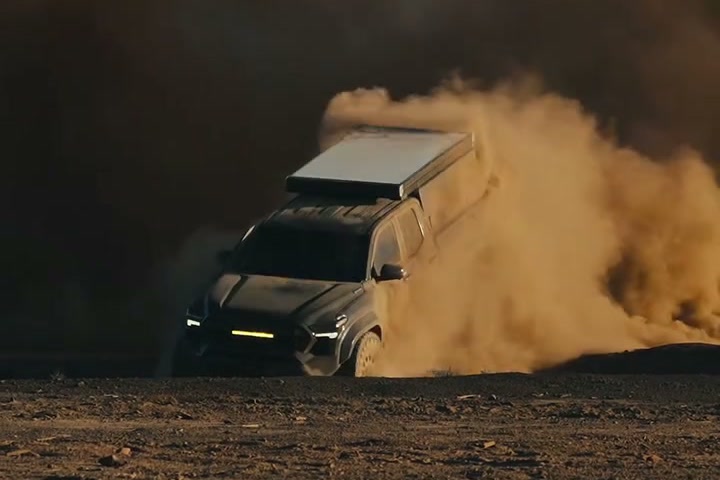
I was committed to a double 360 at thirty miles an hour when I came back through my own dust. Cinders OHV north of Flagstaff is a wide-open volcanic flat with deep craters scattered across it, and the move was to spin two full rotations and drive back out through the cloud I had just kicked into the air. Halfway through the second rotation the dust swallowed the ground, and somewhere in the half second before it cleared I had lost track of one of those craters. When the ground came back, the only thing that mattered was whether the truck answered my right foot the instant I asked.
So does the PedalMonster eliminate throttle input delay? No. Nothing does. I spent twenty years as a competitive gamer chasing exactly that, the gap between a human input and the thing happening on the screen, and you never erase it. You attack it everywhere at once: higher frame rates, higher refresh, lower latency in every link of the chain from your hand to the cable to the panel. You never reach zero. What you get the first time you jump from 60 Hz to 144 Hz is a machine that feels like it is reading your mind. Lag still shows up on a scope. Your hands stop feeling it. That is what the PedalMonster did to my right foot, and after the first drive there was no going back.
What a Custom Tune Can’t Do
A custom tune does a lot of things. Cam’s map sharpened the throttle, raised peak boost, smoothed the i-FORCE MAX’s hybrid hand-offs, taught the eight-speed when to hold a gear and when to drop one. After he handed back my truck I drove it for months and could not imagine asking for more pedal response from a calibration. Factory delay between asking and getting was gone. What was left, I thought, was just physics.
I was wrong about that. What I was actually still living with was a calibration that was frozen in place. Cam wrote one map for the entire pedal sweep, because that is what an ECM tune is, a single static curve burned into the truck. There is no version of it that is sharper at 8 mph and softer at 4 mph. There is no version of it that is different on the freeway than it is in the dirt. I can reflash the COBB from the app in my driveway, but that is a sit-still, swap-the-whole-map operation, not a throttle curve or a launch trim I can shape from a single tap while the truck is moving.
A throttle controller does, and it does it from my phone in one tap. PedalMonster sits between my foot and the pedal sensor. It does not add horsepower or peak torque. What it changes is how much pedal travel I have to spend before the truck reads me as committed. In the dirt I run a High Torque curve with Launch Trim pulled low, and the first quarter inch of pedal asks the truck for what used to take three quarters of an inch. On the street I run a High Performance curve, which fills in the bottom of the pedal where the stock truck feels asleep. Day-to-day driving night-and-day better than stock, no light foot needed to roll out from a stop, the truck answers the moment my foot moves. Same physical pedal, two different trucks, and I switch between them with a button on the iDash that sits on the A-pillar in my line of sight.
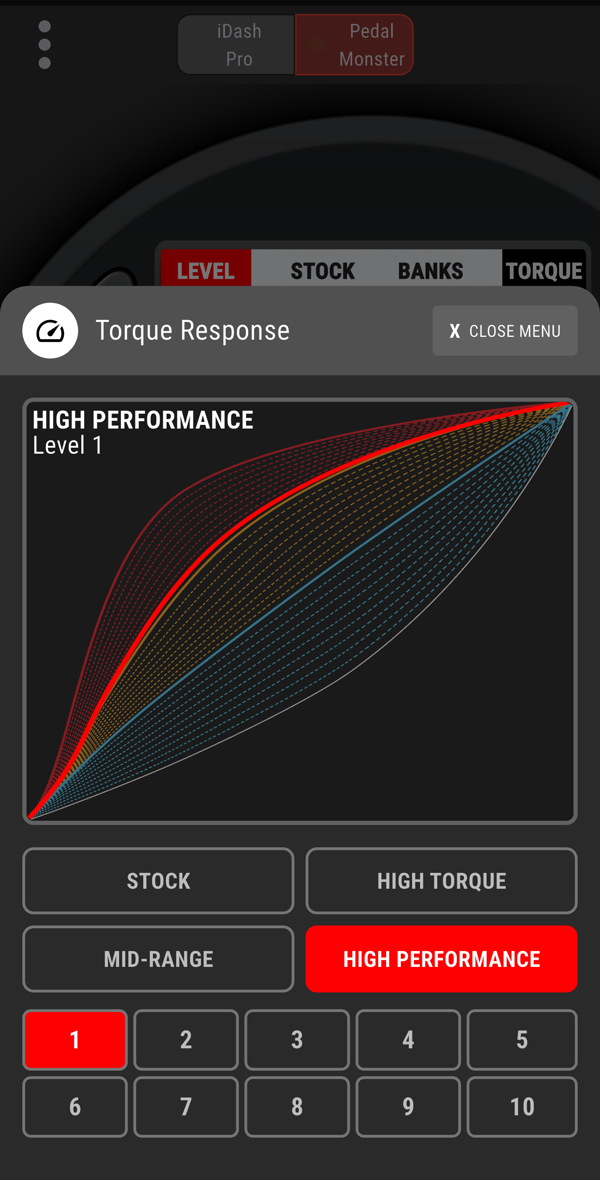
High Performance, Level 1: the curve I actually run on the street.
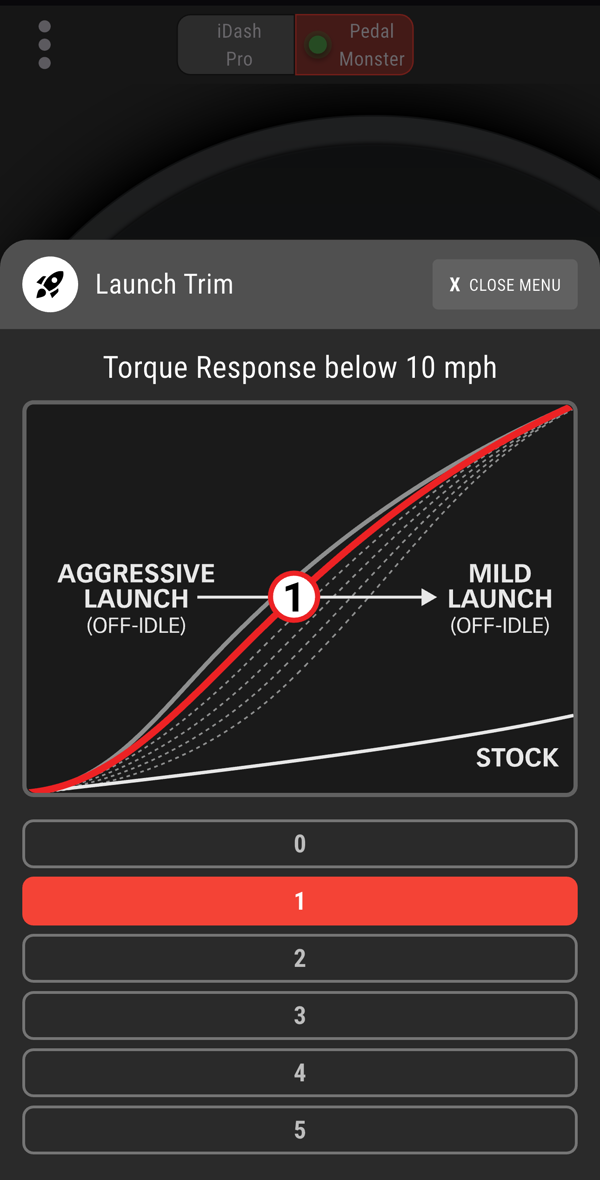
Launch Trim shapes torque under 10 mph. Level 1 is the most aggressive off-idle, what I run in the dirt.
That is the part nobody told me. Not a single forum post, not a single product page, not the Banks marketing video where Gale himself walks through the engineering. Nobody told me that the device’s actual function is letting me have a different truck on the freeway than I have in the dirt, without touching the ECM, without re-flashing anything, on the fly, at speed, with one hand.
What It Feels Like, Driven Hard
On the street, with the High Performance curve, the change is quieter but constant. Stock i-FORCE MAX is limp at low RPM and has a CVT-feeling lull before the turbo spools and the hybrid motor finishes handing off torque to the engine, the kind of soft step-off no tune entirely fixes because it is built into how the powertrain swaps hands. With the curve dialed in, that soft step-off snaps tight. Merging onto Loop 101 is not faster in any measurable way. What it is, is decisive. I ask, the truck answers, the eight-speed quits hunting between 6th and 7th because the kickdown threshold never gets tickled. Less hunting, less downshift kicker, fewer of the small calibration artifacts I had spent two years assuming were just what a hybrid does.
In the dirt I flip to High Torque with Launch Trim low, because the truck wants snap in the first half of the pedal. Deep silt is where it earns its keep. There is always a beat in soft volcanic silt between asking for commitment and getting the answer, and PedalMonster does not erase that beat. Nothing electronic does. What it does is collapse the asking part down to a half inch of pedal, so I spend the rest of my reaction time on steering and line instead of hunting for the throttle. Lag is the same. Interface to it is sharper, and at speed that is the whole game.
Back to the Crater
Now go back to the double 360 at thirty miles an hour, blind in my own dust, a crater I had lost track of somewhere in front of me. That is the moment the whole argument comes down to. When the dust cleared and the ground came back, I had a fraction of a second to either commit to a line around the crater or back out of the throttle entirely, and the truck had to do exactly what my foot told it the instant I told it. On the High Torque curve it did. Off it, with the stock calibration, that fraction of a second includes a beat of throttle lag I would have been fighting at the worst possible moment.
The iDash Earns Its Pillar
I would not run PedalMonster without the iDash. An iDash 1.8 Super Gauge is the screen that pulls a customized PID layout off the OBD bus and turns the A-pillar into a glanceable readout for the data my factory cluster will not show me. Boost, transmission temp, coolant, and the active PedalMonster curve all live there in my line of sight. Curve indicator is the one I check most. Switching from my High Performance street curve to High Torque for the dirt on the fly is a four-button maneuver while the truck is moving, and the iDash tells me where the curve actually landed before I take my eyes back to the trail.
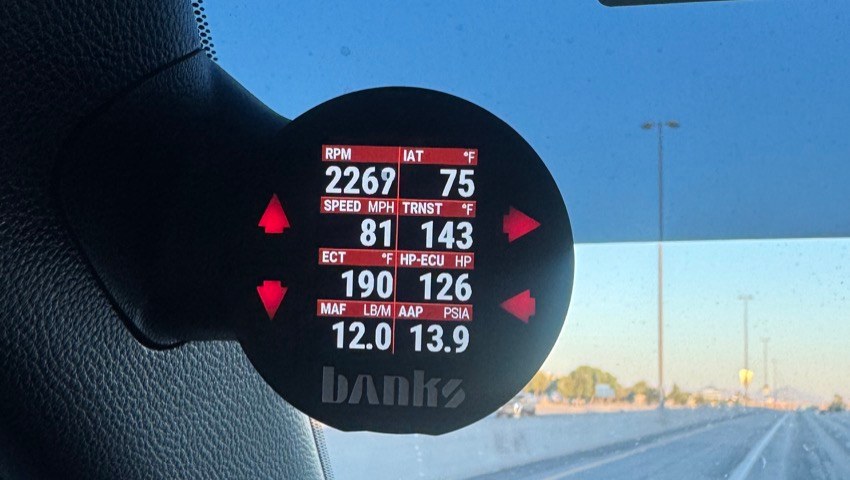
On the pillar, in my line of sight, at speed: trans temp, coolant, boost, and ECU horsepower the factory cluster never shows you.
iDash and PedalMonster talk to each other on Banks’ own bus running through the OBD passthrough cable, which means one cable into the OBD port runs both devices. Install took me a little under an hour with no body panels removed. A Banks app on my phone pairs to the iDash over Bluetooth when I want to reconfigure a layout from the couch. I do that more than I expected; I run an eight-gauge square so I can see everything at once, with a dedicated PedalMonster layout one tap away.
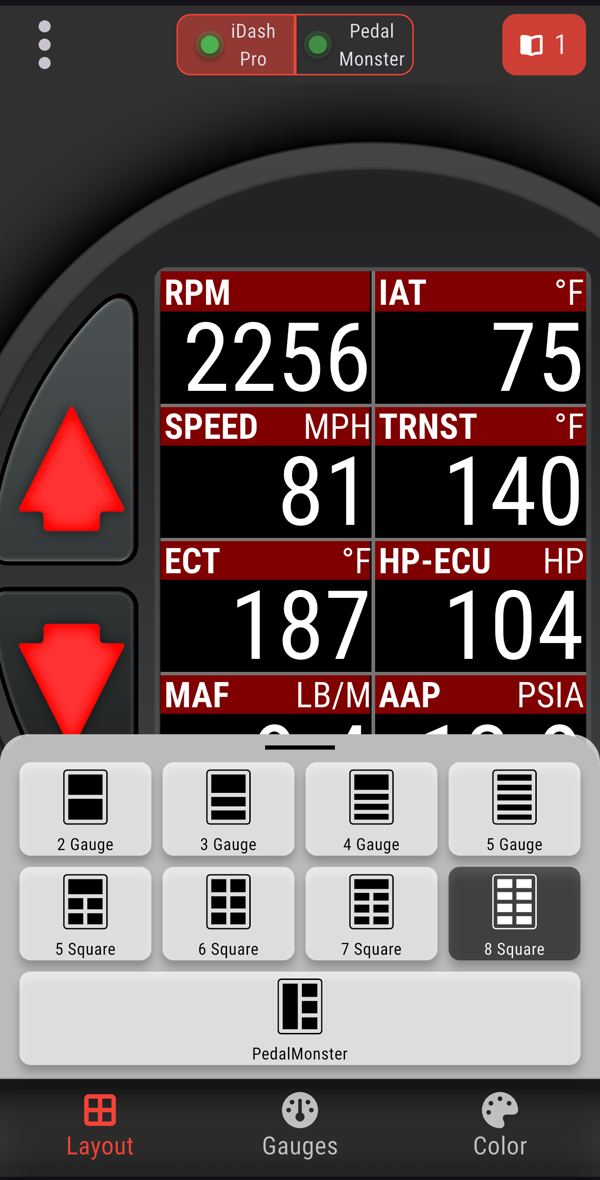
Reconfiguring the layout from the couch over Bluetooth: pick the gauge grid, drop in the PedalMonster page.
Verdict
I have spent two years building this truck. I have learned more about Toyota’s i-FORCE MAX calibration, about portal axle gearing, about charge-air paths, and about silt than I would have ever thought possible. I have written about almost every part on it in this same blog. And I am telling you, plainly, that the cheapest part I have installed has changed how the truck drives more than any of the others.
If you have built a 4G Tacoma to within an inch of its life and you have not tried a PedalMonster, you are leaving the most important calibration off the truck. Run a sharp curve on the street and an aggressive one with the Launch Trim low in the dirt, drive it for a day, and take it somewhere that actually demands something of your right foot.
Buy the PedalMonster and iDash direct from Banks (code PORTALHUNTER for 10% off): shop the Tacoma lineup at Banks.