What You Don't Get from Most Tuners
By Bob Ulrich — videographer and 2024 Tacoma Trailhunter owner behind Portal Hunter
Most shelf tunes change a few numbers and call it done. A real custom calibration rewrites how your truck thinks. Here is what actually changes on the 4th gen Tacoma and what shows up on the road.
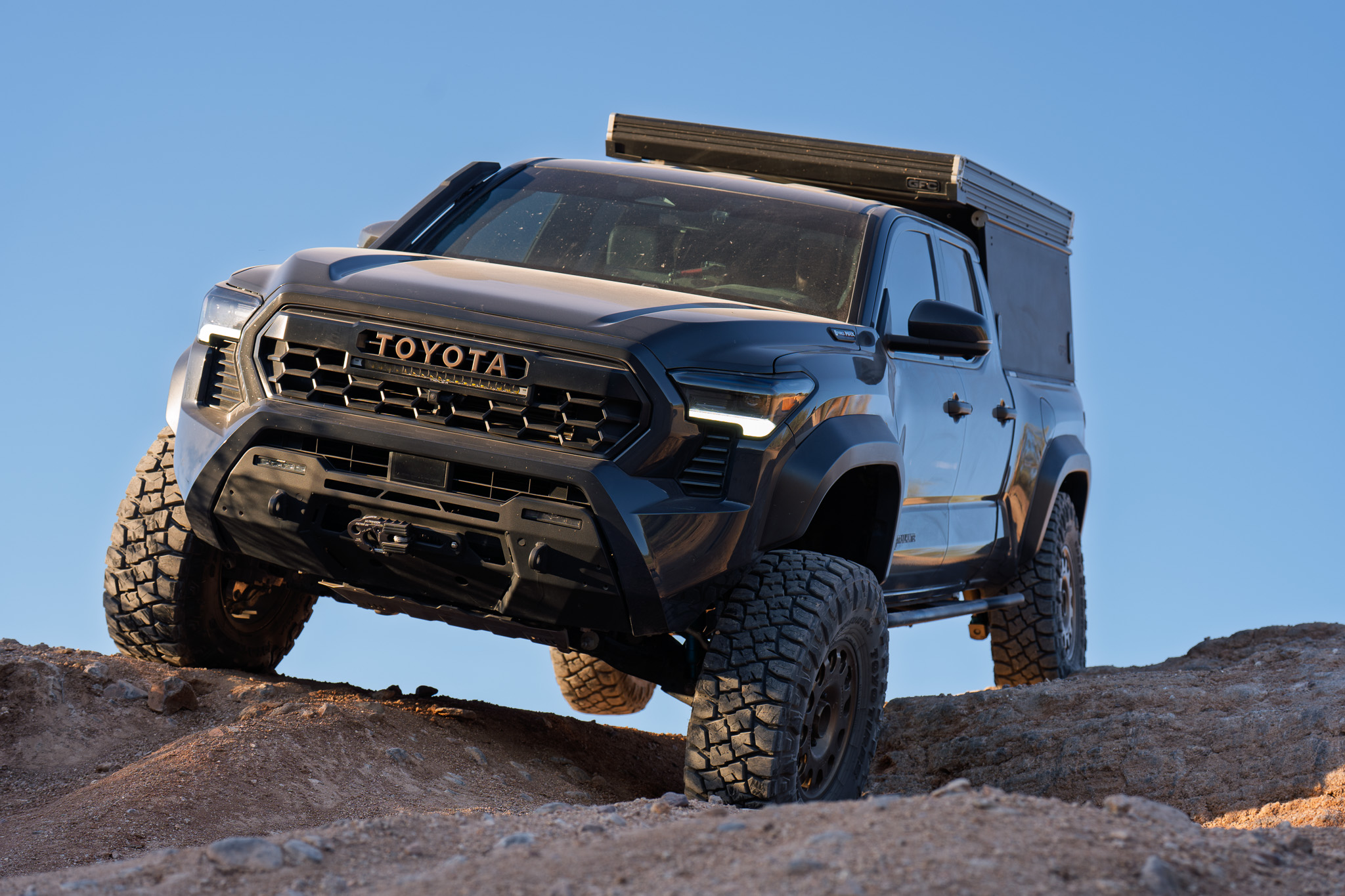
Most people think a tune is about adding horsepower. More boost, more fuel, bigger numbers on a dyno chart. And for a lot of tuners, that is exactly what it is. They load a shelf map onto your ECU, bump the boost targets, and send you on your way with a seat-of-the-pants improvement and zero understanding of what actually changed inside your truck’s brain.
A custom calibration is fundamentally different. My tuner is Cam at CAMTuning Performance, and after running his custom tune on the Trailhunter for thousands of miles across every condition this truck has seen, I want to explain what separates a real calibration from a file download.
What a “Tune” Actually Is
When someone flashes your COBB Accessport with a new calibration, they are rewriting the instructions your ECU and TCU use to make every decision about how the truck runs. This is not a bolt-on part. It is a software rewrite of the truck’s operating logic.
On the 4th gen Tacoma’s 2.4L turbo (and the i-FORCE MAX hybrid), the ECU controls:
- Torque delivery: how much power the engine is allowed to make at any given moment
- Boost control: how much pressure the turbo builds and when
- Fueling strategy: air-fuel ratios across every load condition
- Variable valve timing: when intake and exhaust valves open and close across the RPM range
- Knock detection response: how aggressively the ECU pulls timing when it senses detonation
TCU (transmission control unit) controls:
- Shift scheduling: when the 8-speed automatic changes gears
- Shift firmness: how quickly and cleanly each gear change happens
- Torque converter lockup: when the converter locks for direct drive
- Skip-shift logic: whether the transmission jumps gears under light throttle
A shelf tune might touch boost targets and shift points. A custom calibration touches all of it, calibrated to your specific truck, your driving conditions, and your data logs.
Shelf Tune vs Custom Calibration
A shelf tune is a one-size-fits-all map. Tuner develops it on one truck, maybe two, and sells the same file to everyone. It works. It is better than stock. But it is calibrated for an average truck in average conditions, and your truck is not average.
A custom calibration starts with your data. You install the Accessport, flash an initial calibration, drive the truck, and send data logs back to your tuner. They read the logs, not just the power numbers, but the diagnostic channels that tell them exactly how your ECU is responding to the calibration under real conditions.
Process is iterative. You log, they read, they revise, you flash, you log again. Each revision tightens the calibration to your specific truck. Your altitude. Your fuel quality. Your driving style. Your modifications. My tune on the Trailhunter with 74Weld portal axles and 37-inch tires is not the same tune that goes on a stock TRD Off-Road in Colorado. It should not be.
What a Custom Calibration Actually Changes
Here is what a proper custom calibration modifies on the 4th gen Tacoma platform, and what each one does at the wheels.
Torque Model Refinement
Factory ECU restricts power by monitoring torque output against internal limits. When the engine produces more torque than the ECU expects, it intervenes by pulling timing, closing the throttle, or reducing boost. This is Toyota being conservative, and it is the single biggest reason stock Tacomas feel sluggish off the line and inconsistent under load.
A custom calibration refines the torque models so the engine can deliver smooth, consistent power without the ECU constantly intervening. Result is stronger acceleration and a throttle that does what you ask it to, when you ask it to. Not more power than the engine was designed to make. Same power, delivered without the factory restrictions getting in the way.
Transmission Calibration
This is where the custom tune made the single biggest difference on my truck.
Factory transmission calibration on the 4th gen Tacoma prioritizes fuel economy testing. That means early upshifts, slow downshifts, and constant gear hunting on hills. Transmission is always chasing the tallest gear possible to hit EPA numbers, even when it makes the truck feel indecisive and weak.
A proper recalibration adjusts shift scheduling based on output shaft speed, throttle position, and load, not just RPM. Transmission holds the right gear when climbing. It downshifts immediately when you ask for power. It stops hunting between gears on rolling terrain. Shift points are based on what the truck is actually doing, not what scores best on a federal fuel economy test.
Shift logic is also what made the inverter battery management work during mountain climbs. Tuned shift schedule keeps the engine in its powerband during sustained grades, which gives the hybrid system more headroom to charge the battery while climbing. That was an unexpected benefit of the tune that I did not anticipate.
Fueling Strategy
Tune optimizes air-fuel ratios for each driving condition. Lean and efficient during light cruise. Richer and safer under heavy load and boost. Consistent across altitude and temperature changes.
On the i-FORCE MAX hybrid, this is particularly important. Engine cycles on and off as the hybrid system manages power delivery. Every time the engine comes back online, the fueling needs to be right immediately, not hunting for the correct mixture while the turbo spools. A custom calibration tightens that transition.
Knock Control Integration
This is where most tuners get it wrong and where a custom calibration is fundamentally different.
Many tuners increase boost and timing to make power, then fight the knock detection system when it tries to protect the engine. Some tunes even reduce knock sensitivity to stop the ECU from pulling timing. That is dangerous.
A proper tune works with Toyota’s factory knock sensors, not against them. ECU still monitors knock exactly as Toyota intended. It still pulls timing when it senses detonation. It still adapts to fuel quality, temperature, and load. Where the tune differs is in the space between knock events: how aggressively the ECU adds timing back, how quickly it recovers, how much room it gives the engine to operate efficiently when conditions are good.
Two values to understand here if you are logging:
- Knock Control Learned Value (KCLV): baseline is 15.0. Values above 15 mean the ECU has earned trust in current conditions. Dropping KCLV signals fuel quality issues or heat soak. This is the truck telling you whether it can do what the tune is asking.
- Knock Correction Angle (KCA): -3.0° is the ECU’s neutral baseline, not a problem. Moving toward 0 or positive means the ECU is adding timing under good combustion. Moving below -3.0° means protective timing removal. Both are normal. Tune optimizes how quickly and smoothly the ECU moves between these states.
Variable Valve Timing
Toyota’s 2.4L turbo has variable valve timing on both intake and exhaust cams. Factory calibration is conservative with timing advance at low RPM to stay within emissions targets. A custom tune optimizes the VVT maps to improve low-RPM torque, turbo spool response, and midrange power while keeping emissions hardware functional.
You feel this most in the 1,500-3,000 RPM range where the stock truck feels flat. Tuned truck pulls cleanly from low RPM without the delay you get from the factory calibration.
What Throttle Closure Actually Means
One of the most common complaints in Tacoma forums is the throttle “closing on its own” during acceleration. People feel the truck holding back and assume something is broken.
It is not broken. It is torque management.
Modern turbocharged engines use three tools to control torque delivery: spark timing, boost pressure, and throttle angle. ECU uses all three simultaneously. When you floor it and the turbo builds boost faster than the drivetrain can absorb, the ECU closes the throttle slightly to control the torque spike. This is not a malfunction. This is the same strategy Ford uses on the EcoBoost, VW uses on the TSI, and every modern OEM turbo platform uses.
Factory calibration is aggressive with throttle closure because Toyota calibrates for worst-case scenarios: bad fuel, extreme heat, inexperienced drivers. A custom calibration refines the torque intervention thresholds so the ECU intervenes less frequently and less aggressively while keeping the same safety margins. Throttle still closes when it needs to. It just stops closing when it does not need to.
Output Shaft Speed Beats RPM for Shift Logic
Most people think about shift points in terms of RPM. “The truck shifts at 5,500 RPM.” But the transmission does not use RPM alone to decide when to shift.
Shift scheduling on the 8-speed automatic is primarily based on output shaft speed (OSS), the speed of the transmission’s output shaft after the gear reduction. OSS accounts for the current gear ratio, torque converter behavior, tire size, and load. Same engine RPM can produce completely different shift points depending on road speed and throttle input.
This matters for modified trucks. If you are running 37-inch tires or portal axles that change your effective gearing, the output shaft speed at any given road speed is different from stock. A shelf tune that shifts based on RPM thresholds will not account for this. A custom calibration that considers OSS and your specific drivetrain modifications will.
This is why a custom calibration on a modified truck feels dialed compared to a shelf tune. A tuner who reviews your logs knows the gearing is different. Shift schedule accounts for it.
What You Should See After a Proper Tune
If your tune is calibrated correctly and you are logging with the Accessport, here is what healthy data looks like:
- KCLV holding at or above 15.0 during normal driving
- KCA between -3.0° and +2.0° under most conditions, with the ECU finding its optimal timing
- AFR around 14.5:1 at light throttle, dropping to 11.5-12.5:1 under boost
- Minimal long-term fuel trim correction, meaning the ECU is not having to constantly compensate for a miscalibrated tune
- No persistent knock events at altitude or in heat. Tune adapts, it does not fight
One customer reported monitoring these values at 11,000+ feet elevation with KCA remaining between -3.0° and +2.9° and AFR at 14.5 light throttle dropping to 12.7-13.0 under partial throttle. That is a calibration working exactly as intended under stress.
Dyno Numbers
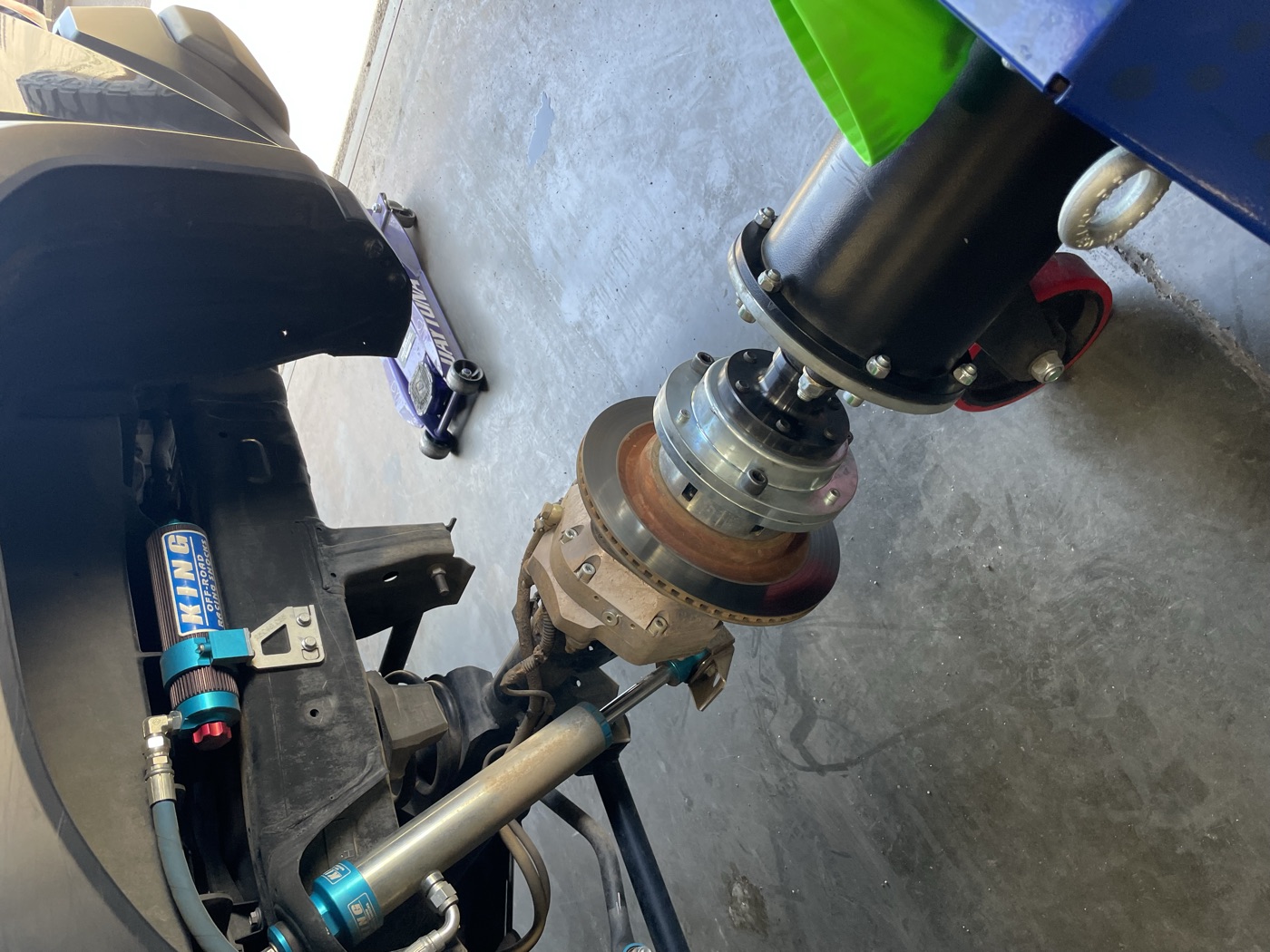
Trailhunter was tuned on a hub dyno at SDHQ in Gilbert, Arizona. A quick note on what these numbers mean: hub dyno results measure power at the wheels, not at the crankshaft. Toyota’s factory rating of 326 HP and 465 lb-ft is a crank figure, before drivetrain losses through the transmission, transfer case, and differentials eat into it. Every truck loses power between the crank and the wheels, so the stock wheel numbers below are lower than the factory spec for that reason, not because the truck is underperforming. What matters on a hub dyno is the delta between runs: same truck, same day, same conditions, different calibration. That is an apples-to-apples comparison.
| Stock Tune | Custom Calibration | Gain | |
|---|---|---|---|
| Peak Torque | 349 ft-lb @ 2,942 RPM | 413 ft-lb @ 2,774 RPM | +64 ft-lb |
| Peak Power | 246.3 HP @ 5,549 RPM | 294.9 HP @ 5,062 RPM | +48.6 HP |
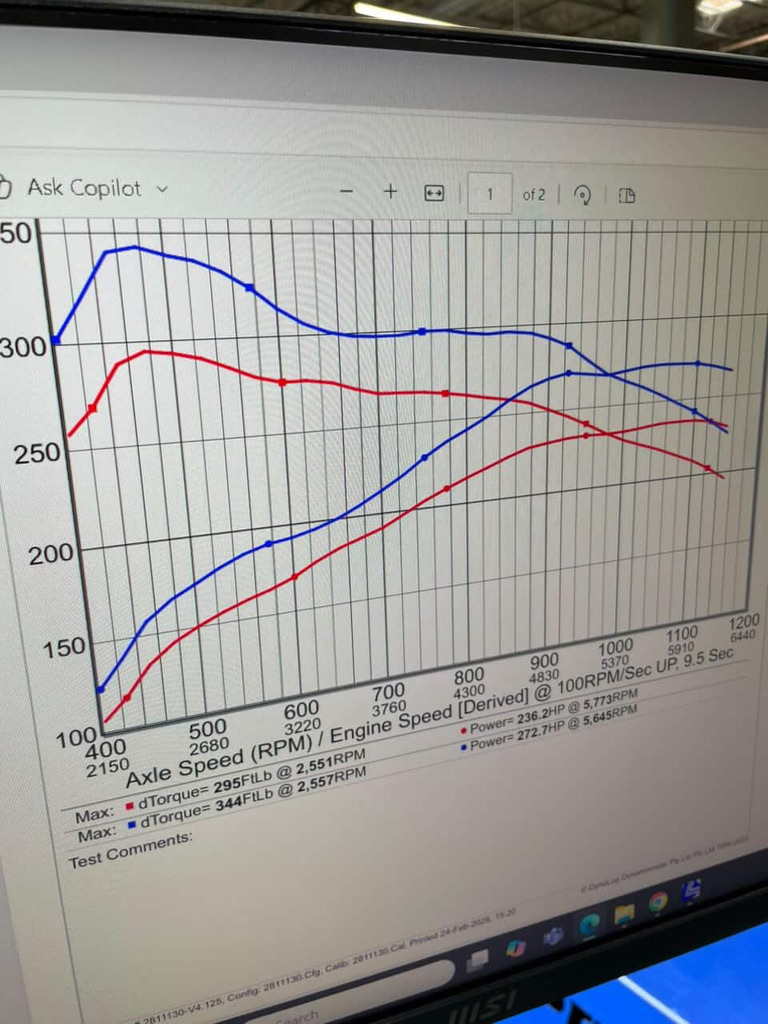
Two things stand out beyond the raw numbers. First, the torque peak moved lower, from 2,942 RPM to 2,774 RPM. That means maximum torque arrives earlier in the rev range, which is exactly what you want on a loaded truck with portal axles and 37-inch tires. You feel this as stronger pull from low RPM without having to wind the engine out.
Second, the power curve is broader. Stock tune drops off sharply after its peak, while the custom calibration holds power longer through the midrange, which means the truck stays in the meat of the powerband during shifts instead of falling off a cliff between gears.
What I Notice Driving It Every Day
Dyno tells one story. Here is what the tune feels like on the road:
Throttle response is immediate. Delay between pressing the pedal and the truck responding is gone. Stock calibration has a noticeable lag between throttle input and power delivery. Tuned truck responds when you ask it to.
Transmission is decisive. No more hunting between 4th and 5th on rolling hills. No more lazy downshifts when you need to pass. Shifts are firm, quick, and happen at the right time. This alone is worth the tune.
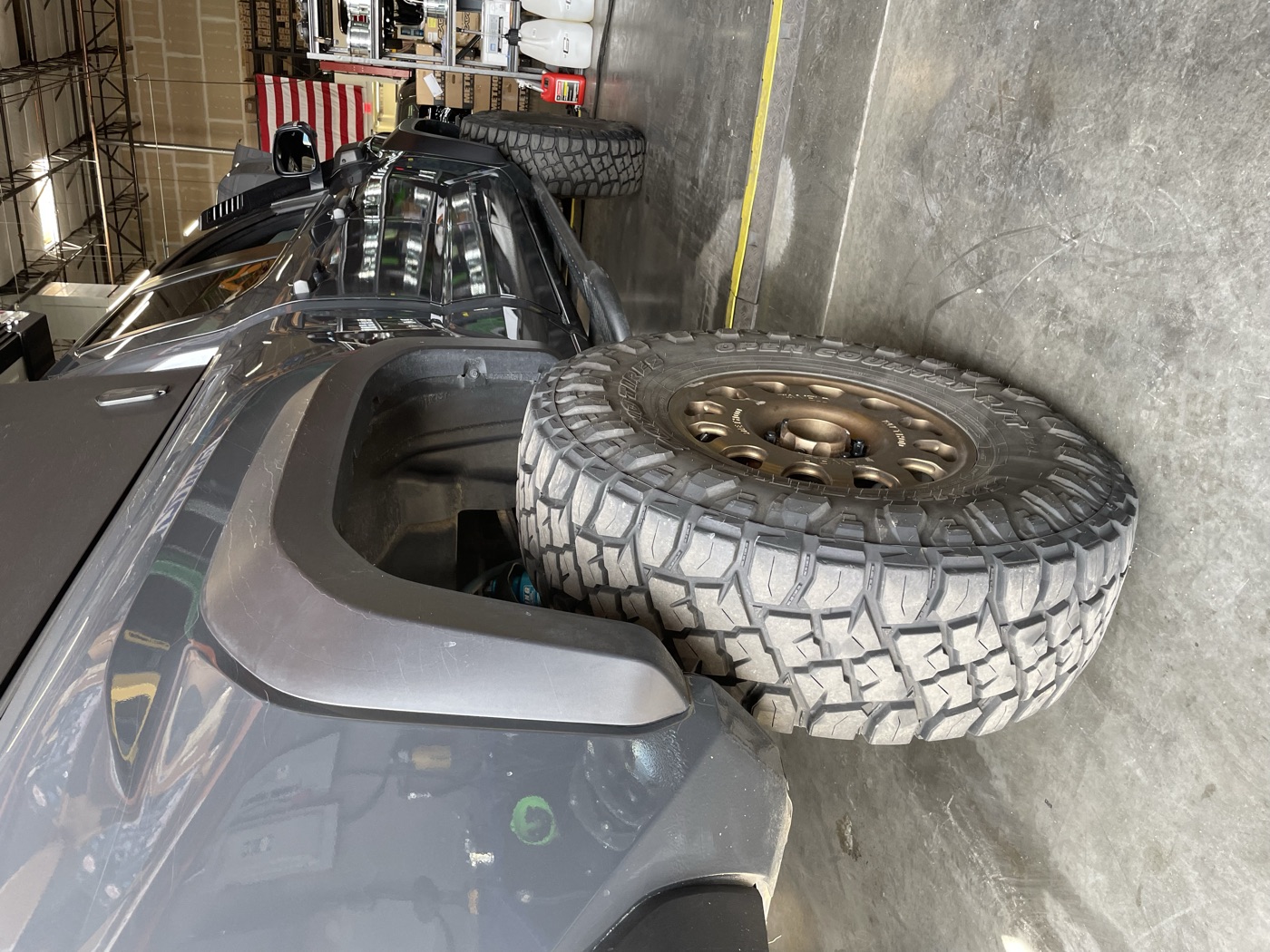
Climbing with 37s and portals is manageable. Stock calibration struggles with the added rotational mass of portal gearboxes and oversized tires. Tuned calibration compensates for it, and the truck pulls up I-17 to Flagstaff without the hesitation and gear-hunting the stock tune produces.
Hybrid system works better. This was the unexpected win. Tuned shift logic keeps the engine in its powerband during climbs, which means the hybrid battery maintains charge better under load. I covered this in detail in the inverter deep dive.
Who This Is For
Not everyone needs a custom tune. If you are driving a stock Tacoma on stock tires with no modifications, a COBB shelf tune is fine. It will improve throttle response and shift behavior meaningfully over stock.
A custom tune makes sense if:
- You have modifications that change the drivetrain behavior (portal axles, regeared differentials, significantly oversized tires)
- You drive in extreme conditions regularly (high altitude, sustained desert heat, heavy towing)
- You want the transmission calibrated specifically for your driving style and use case
- You care about the data and want to understand what your truck is doing, not just feel the difference
My tuner, Cam, works remotely via the COBB Accessport. You send data logs, he sends back revised calibration files. Process takes a few rounds of logging and revision to dial in. It is not instant. But the result is a truck that drives like it should have from the factory.
CAMTuning Performance · @camtuning · COBB Accessport
Full build specs: truck.bdigitalmedia.io/build
Instagram: @portal.hunter
COBB Accessport Guide: Uninstall/Reinstall Walkthrough