The Tacoma's 2400W Inverter Has One Big Problem
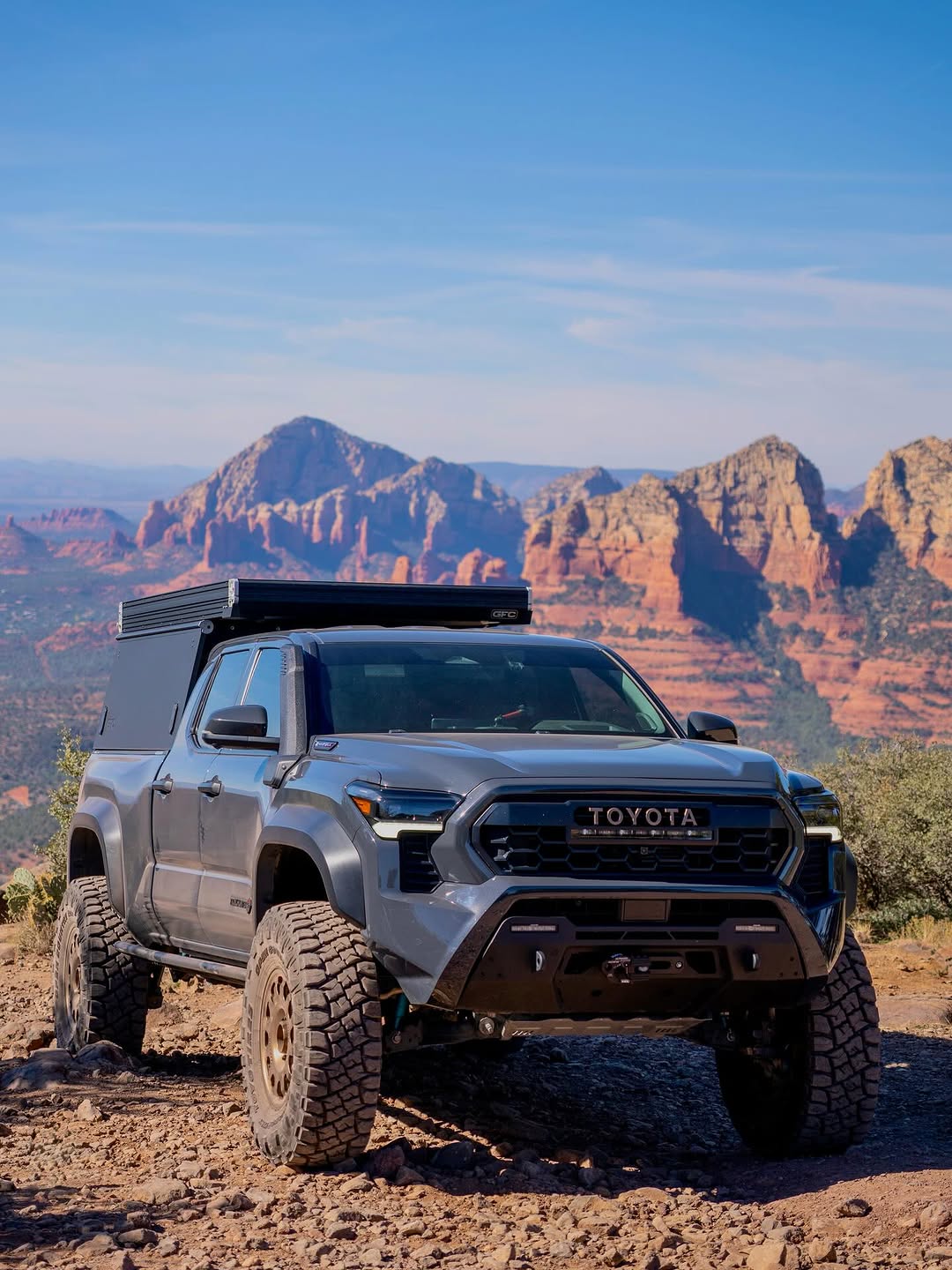
By Bob Ulrich — videographer and 2024 Tacoma Trailhunter owner behind Portal Hunter
32,000 miles. -15°F to 118°F. 500GB streamed. Here's what the Tacoma Trailhunter's 2400W hybrid inverter actually does under real-world stress, and the one problem nobody talks about.
4th Gen Tacoma CAN bus 101 — new to this? Start here
1 What CAN bus does on a 4th gen Tacoma
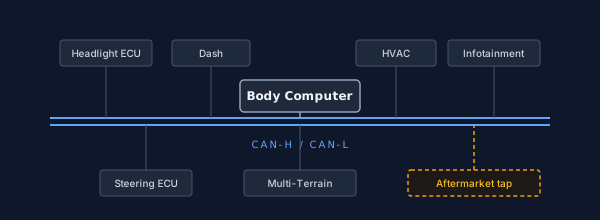
Every module on a modern Tacoma talks to every other module through one shared network called CAN bus. Headlights, dash, infotainment, HVAC, steering controls, all of it rides the same two wires. Swap in an aftermarket accessory that speaks CAN politely, and everything stays happy. Swap in one that does not, and you get warning lights, no-starts, or bricked modules.
2 What a 'drop-in' accessory actually taps into
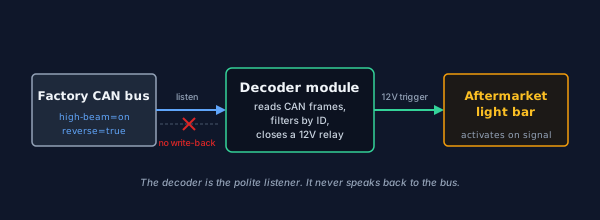
A drop-in lighting kit or auxiliary-power kit usually does not join CAN bus as a peer. It listens to specific factory messages like high-beam on, reverse gear, ignition state, and acts on them. A decoder module does the translation. When vendors skip the decoder and splice straight into lighting outputs, modern Toyotas notice and throw warnings.
3 On a Trailhunter, the bus is more crowded
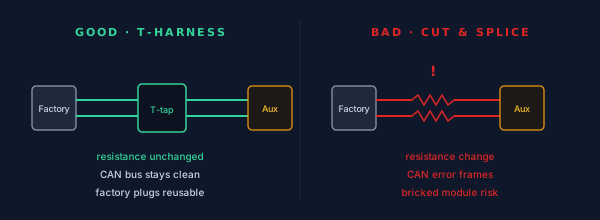
Higher trims ship with more modules on CAN bus than a base truck. A Trailhunter has extra off-road lighting circuits, factory bed scene lights, and the multi-terrain system. More modules means more surfaces where a bad tap-in can trigger a fault. A T-harness passthrough is the safe play. Cut-and-splice is where stories about bricked modules come from.
Toyota’s 2400W inverter on the 4th gen Tacoma is one of those features that sounds like a checkbox on a spec sheet until you actually start relying on it. I have put 32,000 miles on this Trailhunter with a Starlink Mini running inside the GFC off the bed outlet full time. From -15°F in Montana in January to 118°F in the Phoenix Valley in July. Highway, mountain passes, desert camps, rock trails. Over 500GB of YouTube and Netflix streamed through the Starlink on the move (for passengers, of course).
That kind of mileage across those conditions teaches you exactly where this system shines and where it quietly gives up on you. This is everything I have learned about the Tacoma’s AC power system after stress-testing it through every extreme this truck has seen.
Key findings after 32,000 miles and 500GB of video streamed via Starlink Mini:
- The 2400W hybrid inverter delivers full rated power while parked or cruising on flat road
- The hybrid’s 2400W inverter is pure sine wave; the gas-only 400W outlet is modified sine wave
- Sustained mountain climbs deplete the 1.87 kWh NiMH battery, causing inverter power loss
- Sport/Tow-Haul mode reduces battery depletion by keeping engine RPM higher
- Portal axles (22% gear reduction) significantly improved battery management during climbs
- A COBB/CAMTuning flash combined with portals and Sport/Tow-Haul eliminated the problem entirely
How the 2400W Inverter Works
Toyota’s 4th gen Tacoma i-FORCE MAX hybrid powertrain is the foundation of the inverter system. Here are the specs that matter:
- Engine: 2.4-liter turbocharged four-cylinder
- Electric motor: 48 horsepower, integrated into the 8-speed automatic transmission
- Combined output: 326 hp / 465 lb-ft of torque (peak torque at 1,700 RPM)
- Hybrid battery: 1.87 kWh nickel-metal hydride (NiMH)
- Inverter: 2400W pure sine wave (bed outlet), 400W (cabin outlet)
That 2400W AC inverter is part of the i-FORCE MAX package. It converts power from the high-voltage hybrid battery into standard 120V AC household power delivered through outlets in the bed and cabin. This is a pure sine wave inverter, which matters. Gas-only Tacomas get a 400W inverter that runs on a modified sine wave. Compatibility is the key distinction. Modified sine wave power causes issues with sensitive electronics, solar generators, and battery management systems. Hybrid’s pure sine wave output works cleanly with everything I have plugged into it, including the Starlink Mini, a Goal Zero Yeti 1500X, and various chargers.
Which Trims Get It
Every i-FORCE MAX hybrid Tacoma gets the 2400W inverter as standard equipment. It is not a separate option. If your truck has the hybrid powertrain, you have the 2400W pure sine wave system. On the 4th gen Tacoma, the hybrid powertrain is standard on TRD Pro and Trailhunter and optional on TRD Sport, TRD Off-Road, and Limited trims. Pick the hybrid on any of those and the 2400W inverter comes with it. Non-hybrid 2.4L turbo models only get a 400W modified sine wave outlet, a completely different system, not just a lower-wattage version of the same inverter.
6th gen 4Runner also gets the 2400W inverter through its i-FORCE MAX powertrain. Every 2025+ 4Runner trim is hybrid, and the TRD Pro and Trailhunter come with the 2400W bed outlet standard. It is available on the TRD Off-Road, Limited, and Platinum trims as well. If you are cross-shopping a Tacoma and 4Runner and AC power is a factor, both platforms deliver the same 2400W pure sine wave capability.
Sources: Toyota USA Newsroom: 2024 Tacoma i-FORCE MAX, Toyota USA Newsroom: 2025 4Runner
What About Tundra, Sequoia, and Land Cruiser
Both the Tundra and Sequoia have the i-FORCE MAX hybrid system with a twin-turbo 3.5L V6, but they use a 400W inverter, not the 2400W system. I have firsthand experience with this limitation on the Sequoia. While driving, the 400W outlet has a 100W cap, and even a Starlink Mini can spike above 100W during initial boot or firmware updates. A MacBook charger pulls 67-140W depending on the model. Both will trip the inverter and shut it off mid-drive. That is a real problem on a $75,000 truck. Its outlet cannot reliably power the two most common devices people want to use on the road. Forum discussions on Tundras.com show Tundra owners attempting to swap the Tacoma’s 2400W inverter into their trucks, which tells you the demand is there but the factory solution is not.
Land Cruiser is a different story. Both the 2025 and 2026 models come standard with the 2400W inverter as part of their i-FORCE MAX package.
If you are shopping across the Toyota truck lineup specifically for the 2400W bed outlet, the Tacoma, 4Runner, and Land Cruiser all have it. Tundra and Sequoia are not there yet.
Where You Can Access the Power
Here is a quick reference for how the AC outlets break down across the 4th gen Tacoma lineup:
| Hybrid (i-FORCE MAX) | Gas (2.4L Turbo) | |
|---|---|---|
| Bed outlet | 2400W (20A @ 120V) | 400W |
| Cabin outlet | 400W | 400W |
| Inverter type | Pure sine wave | Modified sine wave |
| While driving | Active (battery-managed) | 100W hard cap |
| In park | Full rated wattage | Full rated wattage |
| Power source | High-voltage hybrid battery | 12V system |
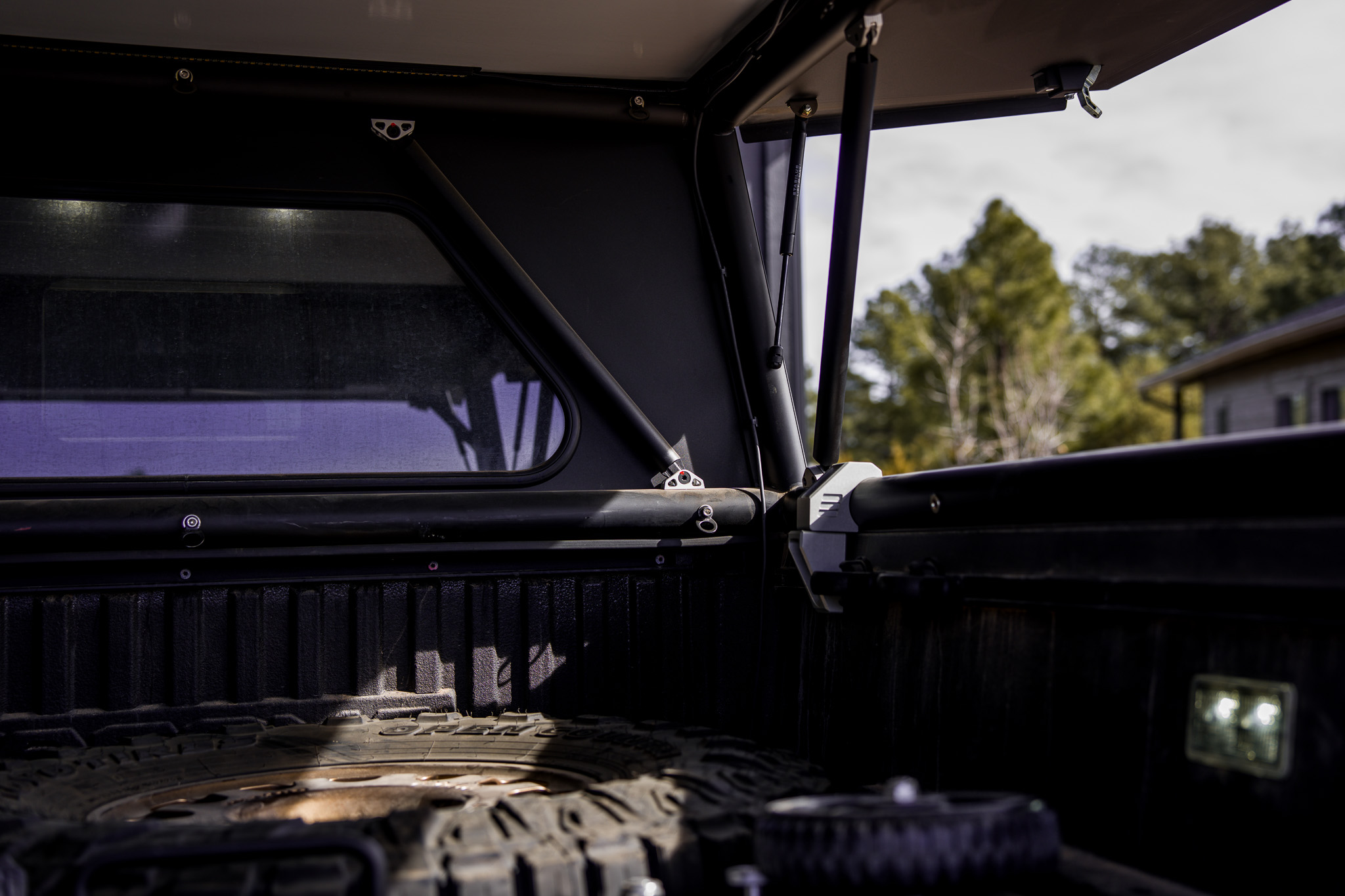
i-FORCE MAX Tacoma has two 120V AC outlets:
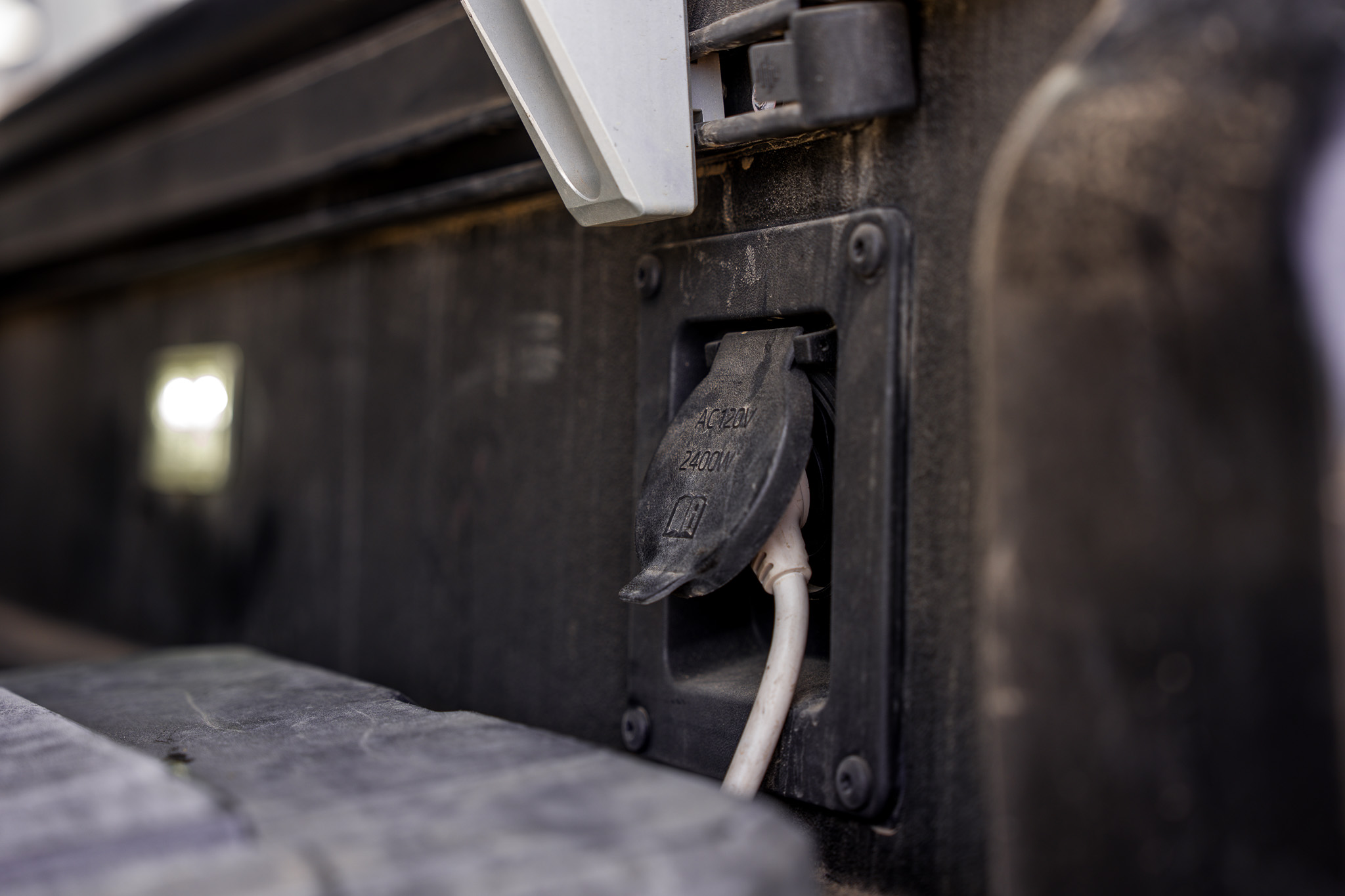
Bed outlet. This is the main event. On hybrid models, this outlet is rated at 2400W (20 amps at 120V). It draws power from the high-voltage hybrid battery and is the outlet you want for anything that pulls real wattage. It is located on the driver’s side of the bed near the bulkhead.
Cabin outlet. Located at the rear of the center console, this outlet is rated at 400W. Useful for charging laptops or smaller devices, but not built for sustained high-draw applications.
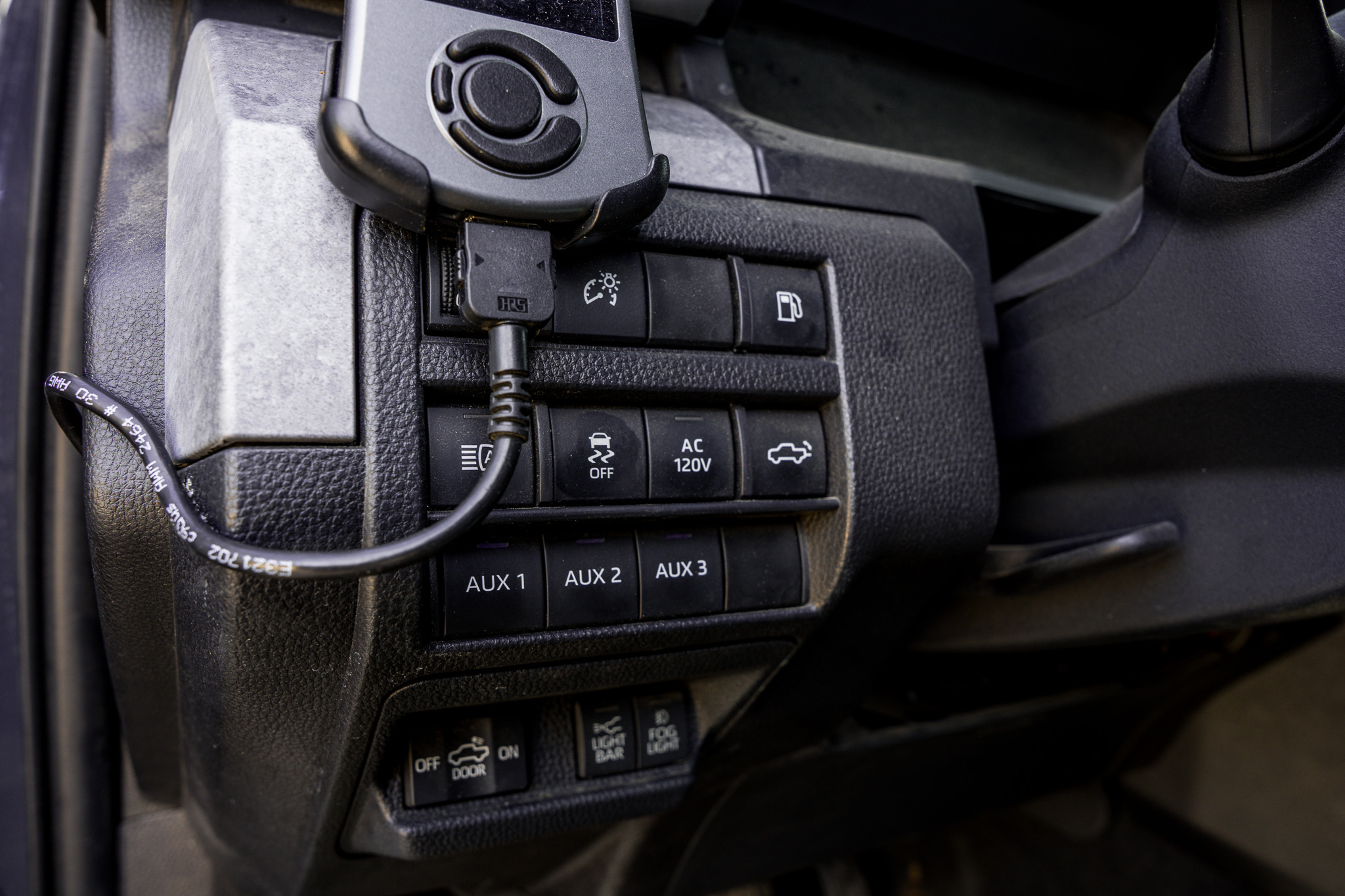
Power switch. Both outlets are controlled by a single power outlet switch located to the left of the steering wheel. Flip it on and both outlets go live. Vehicle needs to be in ACCESSORY or ON mode.
Beyond the AC outlets, you also get 12V DC power outlets and USB-C ports in the cabin and bed. But for running something like a Starlink dish, the 120V bed outlet is the one that matters.
For comparison, non-hybrid Tacomas with the 400W inverter get a bed outlet capped at 400W in park and 100W while driving. That 100W driving limit is a hard cap on gas models and is not enough to reliably run most devices on the move. By contrast, the hybrid’s 2400W outlet does not have this same hard cap. It draws from the traction battery, which the engine continuously manages. This distinction is critical and is the reason the hybrid is the only real option if you want to run accessories off AC power while driving.
Sources: Tacoma4G: Bed 120V Outlet Questions, 4GTaco: 120V AC Power Outlets 400W vs 100W
Driving vs. Stationary vs. Engine Off
Understanding how the inverter behaves in different states is the key to using it effectively.
Parked with Engine Running
This is the best-case scenario. Engine runs, charges the hybrid battery, and the 2400W outlet delivers full power. System cycles the engine on and off as needed to maintain battery charge. If you are drawing moderate power (a few hundred watts), the engine may shut off for stretches and let the battery handle it, then kick back on to recharge. For something like the Starlink Mini pulling 25-40W, the engine cycles are infrequent.
Parked with Engine Off
There are two states here worth understanding. If the vehicle is in READY mode (push start, but engine not running), the hybrid system manages itself. Its 1.87 kWh NiMH battery powers the inverter at the full 2400W rating, and the engine will automatically cycle on when the battery needs charging. Forum reports on Tacoma4G show the engine kicking in within a minute under moderate loads (like a 10,000 BTU air conditioner). For the Starlink at 25-40W, the battery can sustain it longer before the engine cycles on, but you should not expect extended silent operation. NiMH chemistry charges slowly above 80% state of charge, which means the engine may run longer than you would expect to top the battery back up.
If the vehicle is fully OFF (not in READY mode), the inverter can still operate but at a reduced 400W output from the battery alone. Engine will not auto-start in this mode, and the small battery will eventually deplete and shut the inverter off.
Trailhunter also has a dedicated Generator Mode that optimizes the engine cycling specifically for stationary power delivery. Toyota has announced that Generator Mode will expand to other i-FORCE MAX trims via software update, which is good news for anyone who bought a TRD Off-Road or Limited hybrid.
Driving
This is where things get interesting. While driving on flat highway, the system manages itself well. Engine powers the drivetrain and charges the battery through regenerative braking and direct charging. Inverter draws from the battery, engine keeps it topped up, and everything runs smoothly. Starlink stays connected, battery stays stable, and you do not think about it.
Problems show up when you are climbing.
Our Setup: Starlink Mini Inside the GFC
Starlink Mini lives inside the GFC V2 Pro camper on the Trailhunter. Power cable runs from the 120V AC bed outlet, through the GFC floor panels, and up to the dish. Mini itself is suction-cup mounted to the inside of the GFC roof plastic, hidden underneath the Pro Headliner upgrade kit. From the outside, you would never know it is there. From the inside, the headliner covers the dish completely and the cable routing is clean through the floor panels with no exposed wiring in the bed area.
AC outlet switch to the left of the steering wheel stays on whenever we are moving or camped.
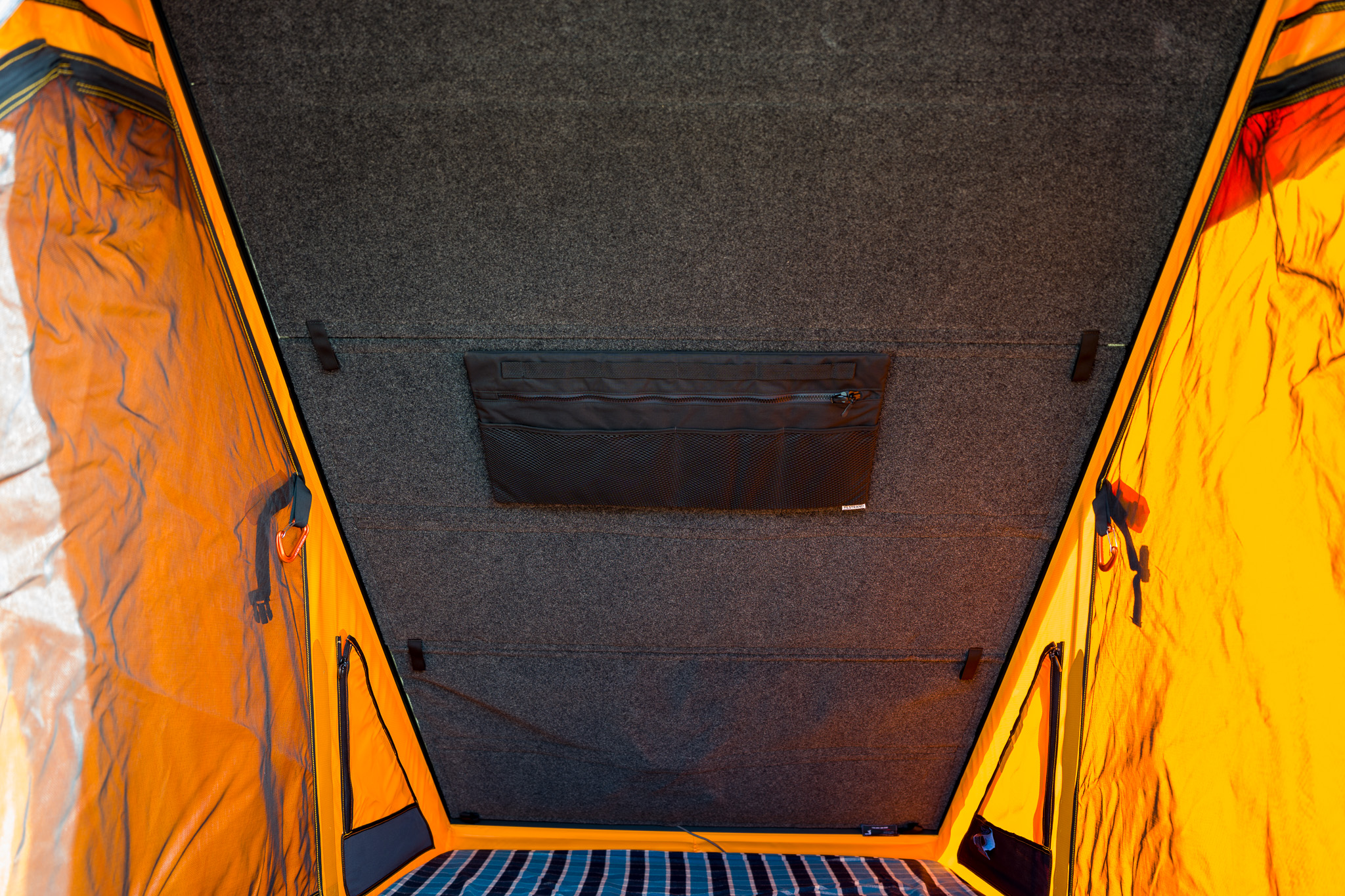
Filstrand Upper Decker
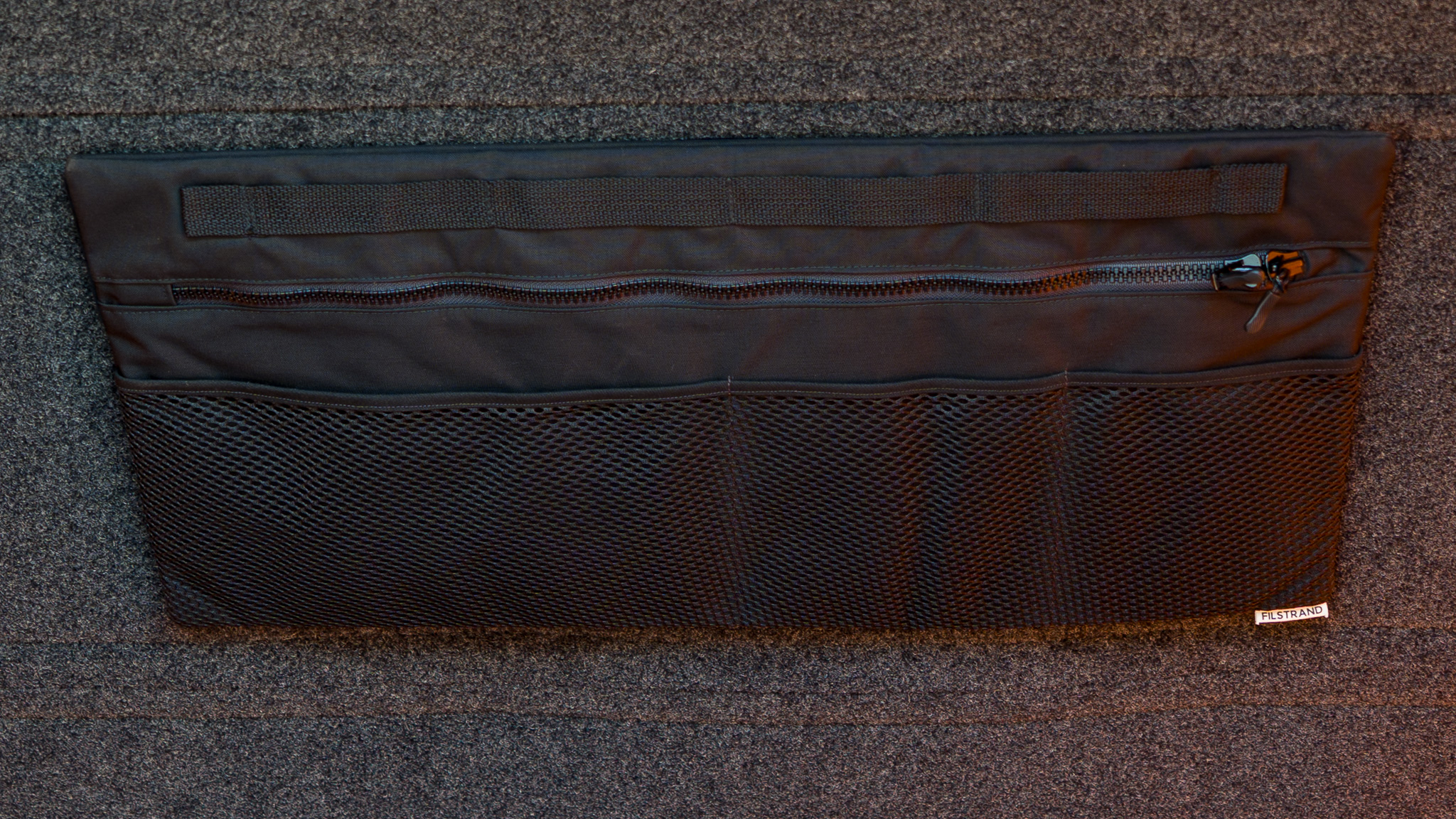
If you have spent any time sleeping in a GFC, you know the problem: you are lying in the tent, phone in hand, headlamp somewhere in the sheets, battery pack wedged under your pillow. Mesh pockets down by your feet are fine for daytime storage, but at night they are too far away to be useful. And if you camp in cold weather, anything left in those lower pockets is exposed to the elements. Anyone who has woken up to solid frozen keys in Montana at -15°F learns that lesson fast.
Filstrand’s Upper Decker solves this. It is a 25” x 12” overhead organizer that mounts to the GFC ceiling with Velcro hook pads. Three mesh compartments, a large zippered pocket, and a webbing strip along the top for clipping smaller items. I had mine custom made in black to match the headliner. Everything you need while lying down (phone, headlamp, battery pack, ear plugs) sits right above your head where you can reach it without moving.
Filstrand is a small operation handcrafting these in Southern California. They build for GFC, Super Pacific, Lone Peak, and Topo Topper Mesa campers, and they will work with you on custom colorways and pocket configurations. Upper Decker runs $125-$135 depending on color. It is one of those products that is so simple and well-made that you wonder why it was not included from the factory.
Starlink Mini draws 20-40 watts during normal operation and up to 60W at peak, which is nothing relative to the 2400W capacity of the outlet. On paper, this should never be a problem. Outlet can deliver 2400 watts. Dish needs 40. That is less than 2% of the available capacity.
For highway driving, flat desert roads, and camp, this setup is flawless. Starlink boots up in about 90 seconds, connects to the constellation, and provides reliable internet from the truck bed no matter where we are parked. It has worked at King of Hammers, in Sedona, across the Mojave, and at elevation in Flagstaff. Connectivity where there is no cell signal changes how you travel.
Outlet capacity is not the problem. What happens to the battery that feeds it when the truck is working hard is.
Problem: Sustained Mountain Climbs
I-17 from Phoenix to Flagstaff is where this issue became obvious. You are climbing from roughly 1,100 feet in the Valley to over 7,000 feet at Flagstaff, with sustained grades through Black Canyon City and up the Mogollon Rim. In this truck, loaded with 74Weld Gen2 portal axles, 37-inch Toyo RT Pros, the GFC V2 Pro, a CBI Covert bumper with a Warn Zeon 10S winch, and Westcott Designs rock sliders, climbing a sustained 6% grade is real work. You can see every component on the full build specs page.
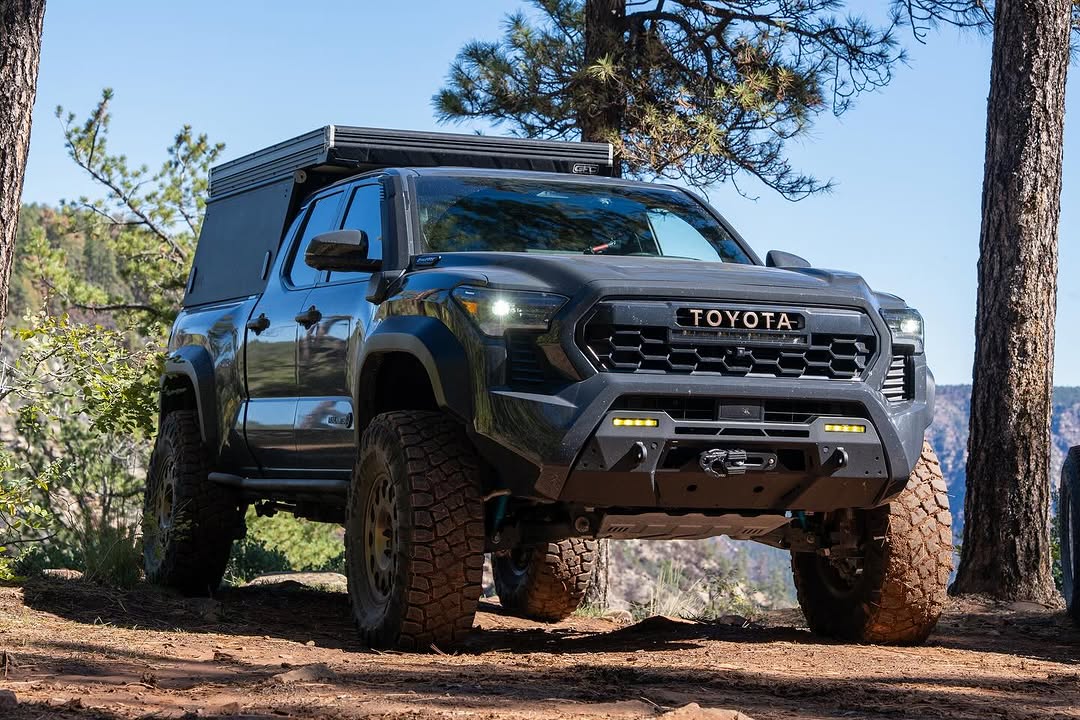
Here is what happens during a sustained climb. i-FORCE MAX faces three simultaneous demands:
- Propulsion. Both the 2.4L turbo and electric motor are working to push the truck uphill. This is where most of the energy goes.
- Electric motor assist. Drawing from the NiMH battery, the 48-hp motor supplements the gas engine during acceleration and climbing. Harder climbs mean more motor assist and faster battery depletion.
- Inverter load. That same battery feeds the 2400W outlet to power whatever is plugged in.
On flat ground, the engine has spare capacity to charge the battery while driving. On a sustained climb, it does not. Engine output is at or near maximum just for propulsion, while the battery is being drained by both the electric motor assist and the inverter load. Even though the Starlink is only pulling 25-40W, that draw is additive on a battery that is already being depleted by the drivetrain.
Result: the hybrid battery level drops progressively during sustained climbs. Battery gauge on the multi-information display shows the bars falling. If the level drops low enough, the system prioritizes the drivetrain and the inverter output becomes unreliable. Starlink loses power. It reboots. You lose your connection.
This is not a malfunction. This is the hybrid system doing exactly what it is designed to do: prioritize propulsion over accessories when the battery cannot keep up. But if you are relying on continuous power to a device in the bed, it is a real problem.
How I Have Offset This
I have tested several approaches to solve this problem over the past year. Here is what worked, what did not, and where I ultimately landed.
Approach 1: Goal Zero Yeti 1500X as a Buffer
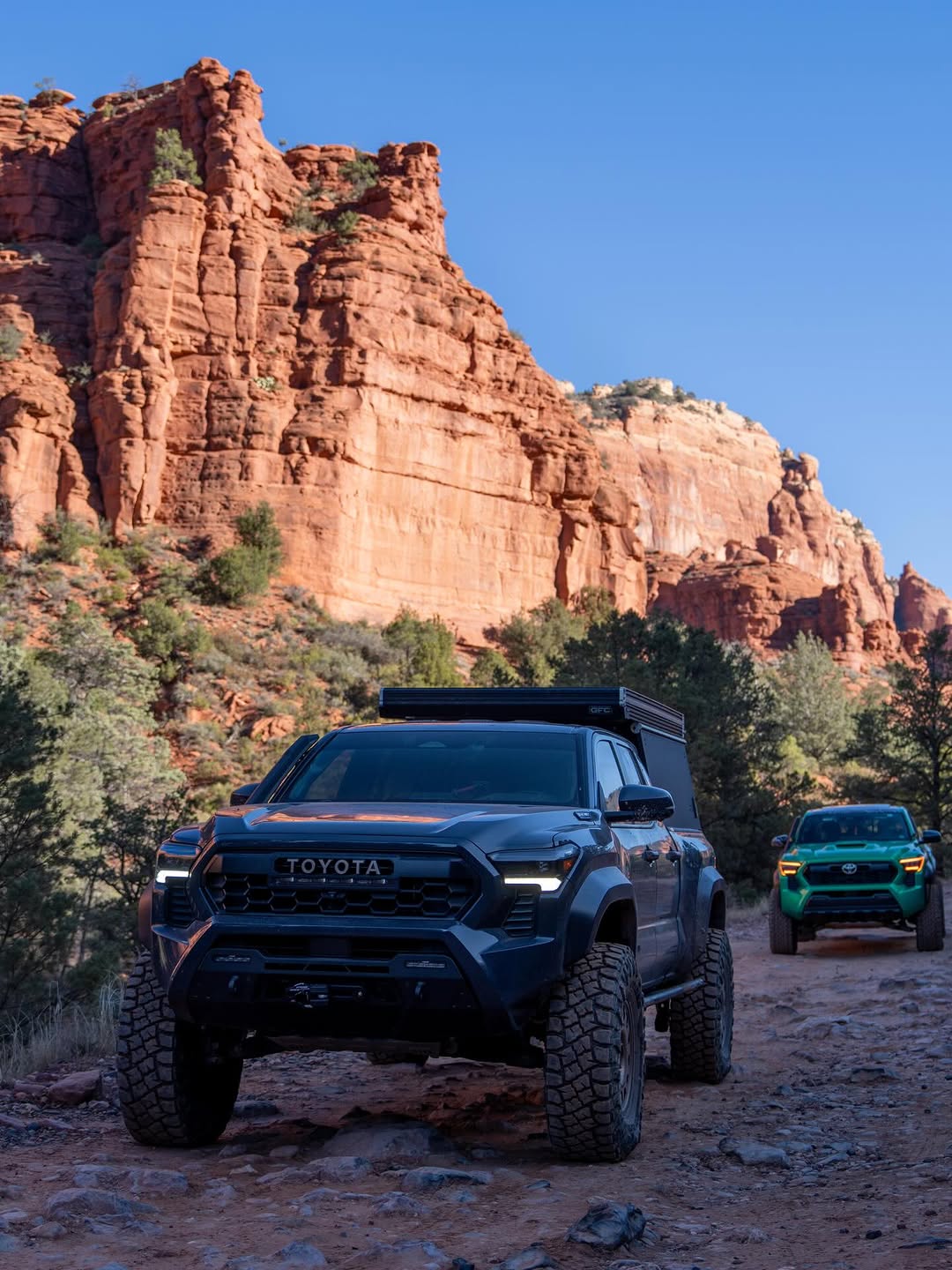
My first solution was to decouple the Starlink from the truck’s inverter entirely. I ran a Goal Zero Yeti 1500X inside the GFC to power the Starlink, then used the truck’s 120V AC outlet to charge the Goal Zero when the system had capacity. This way, the Starlink draws from the Goal Zero’s lithium battery, not the truck’s NiMH pack. During mountain climbs, the truck’s inverter can drop without affecting the Starlink because it is running off an independent power source.
This works. Starlink stays connected through mountain passes because it is electrically isolated from the truck’s hybrid system. When the truck is cruising on flat road or parked, the AC outlet charges the Goal Zero back up.
Two problems:
- More stuff. Another 45-pound battery to pack, carry, position, and wire inside the GFC. More cables, more things to forget or damage. Simplicity is the goal with overlanding gear, and this adds complexity.
- Heat. Goal Zero Yeti 1500X has a safe operating range of 32-104°F. Inside the bed of the truck in Arizona during summer, temperatures regularly exceed 110°F ambient. Inside the GFC with the panels closed, bed temperatures can push well past 120°F. At those temperatures, the Goal Zero triggers its high-temperature protection, stops charging and discharging, and runs its fans at maximum to cool down, which drains the battery faster. A portable power station that shuts down in the climate you use it in is not a reliable solution.
Goal Zero approach proved the concept. Isolating the Starlink from the truck’s power system keeps it running during climbs. But carrying a separate power station that overheats in your primary operating environment is a band-aid, not a fix.
Approach 2: Sport Mode and Tow/Haul
Next, I tried changing how the truck manages its own power during climbs, using the drive modes Toyota already built in.
Sport mode changes throttle mapping, shift points, and steering feel. In Sport, the transmission holds gears longer and downshifts more aggressively, keeping the engine at higher RPM through climbs instead of lugging at low revs in a tall gear.
Tow/Haul mode is designed for loaded driving. According to Toyota, it provides “enhanced throttle response and transmission functionality while towing.” Forum discussions on Tacoma4G suggest that Tow/Haul mode “saves the battery life for hard acceleration or uphill climbs” by keeping the engine engaged more consistently rather than cycling off.
My observation running both Sport and Tow/Haul on the I-17 climb: the engine holds higher RPM, the transmission uses lower gears, and the battery level appears to deplete more slowly during sustained grades. Logic makes sense. Higher RPM means the engine is producing more power relative to demand, which gives the charging system more headroom to maintain the battery. Lower gears mean the engine is working more efficiently within its powerband rather than straining at low RPM in a gear that is too tall for the grade.
I want to be transparent here: this is observational, not scientifically measured. I did not log battery voltage or charging current. I watched the battery gauge on the dash during repeated drives on the same route and saw a noticeable difference. Battery still depleted during the steepest sections, but it recovered faster on the brief flat stretches between grades. Sport/Tow-Haul improved the situation. It did not eliminate it.
Approach 3: Portal Axles
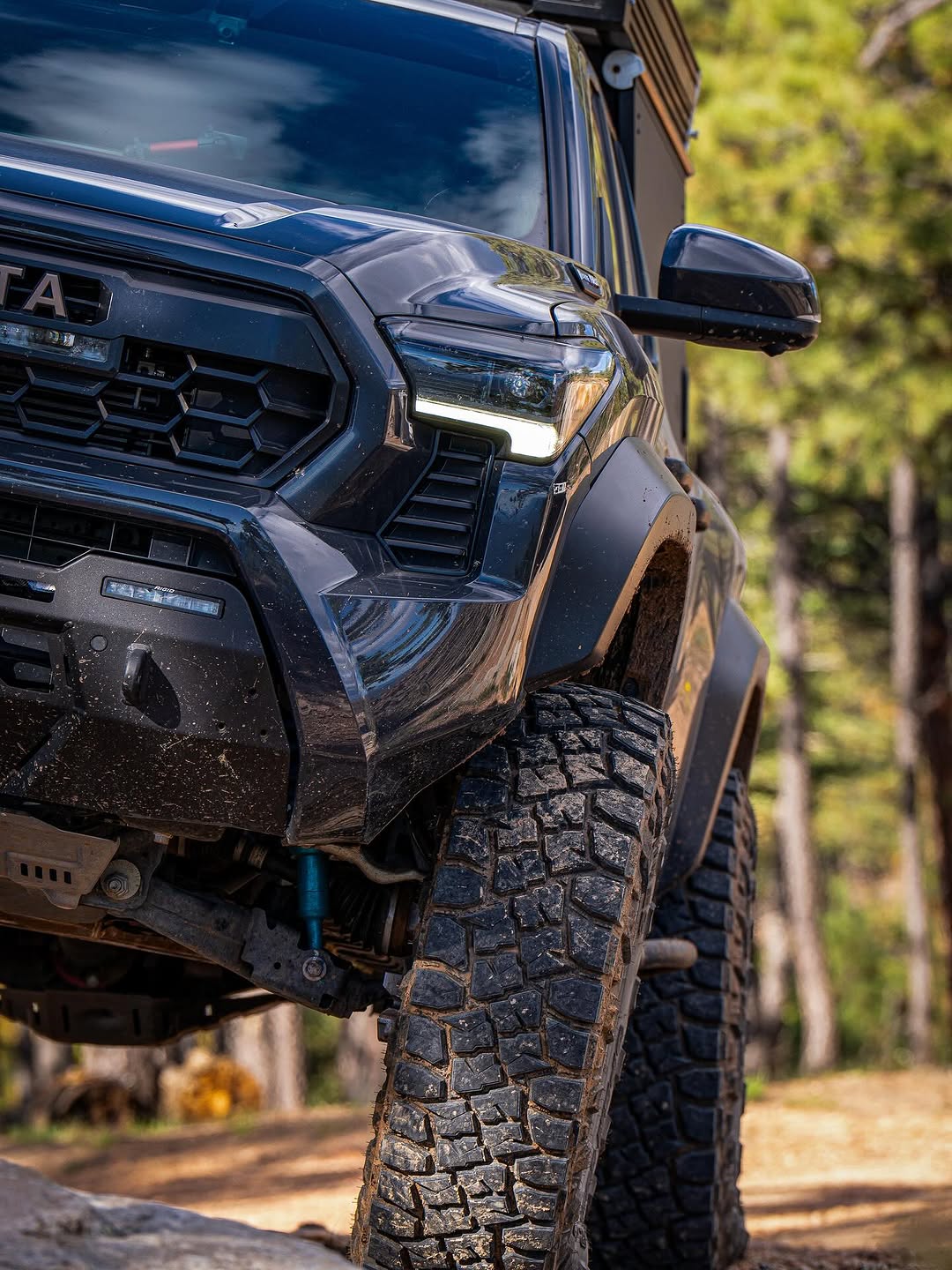
This is where the build itself started solving the problem.
74Weld Gen2 portal axles on the Trailhunter provide a 22% gear reduction at each wheel. That gear reduction changes the truck’s effective overall gearing. With the portals installed, the same road speed corresponds to higher engine RPM, and the transmission selects lower gears for the same driving condition. Engine spins faster, working within a more efficient part of its powerband during climbs.
Result on the same I-17 climb: noticeably better battery management. Higher engine RPM generates more charging capacity while lower effective gearing reduces the peak torque demand on the drivetrain. Electric motor does not need to assist as aggressively because the gearing is doing more of the work. Less motor assist means less battery drain. More engine RPM means more charging.
This was not the reason I installed portal axles. Portals went on for ground clearance, wheel articulation, and trail capability. But the side effect on the hybrid power management during highway climbing was significant and unexpected.
Approach 4: Portals + Sport/Tow-Haul + COBB Tune
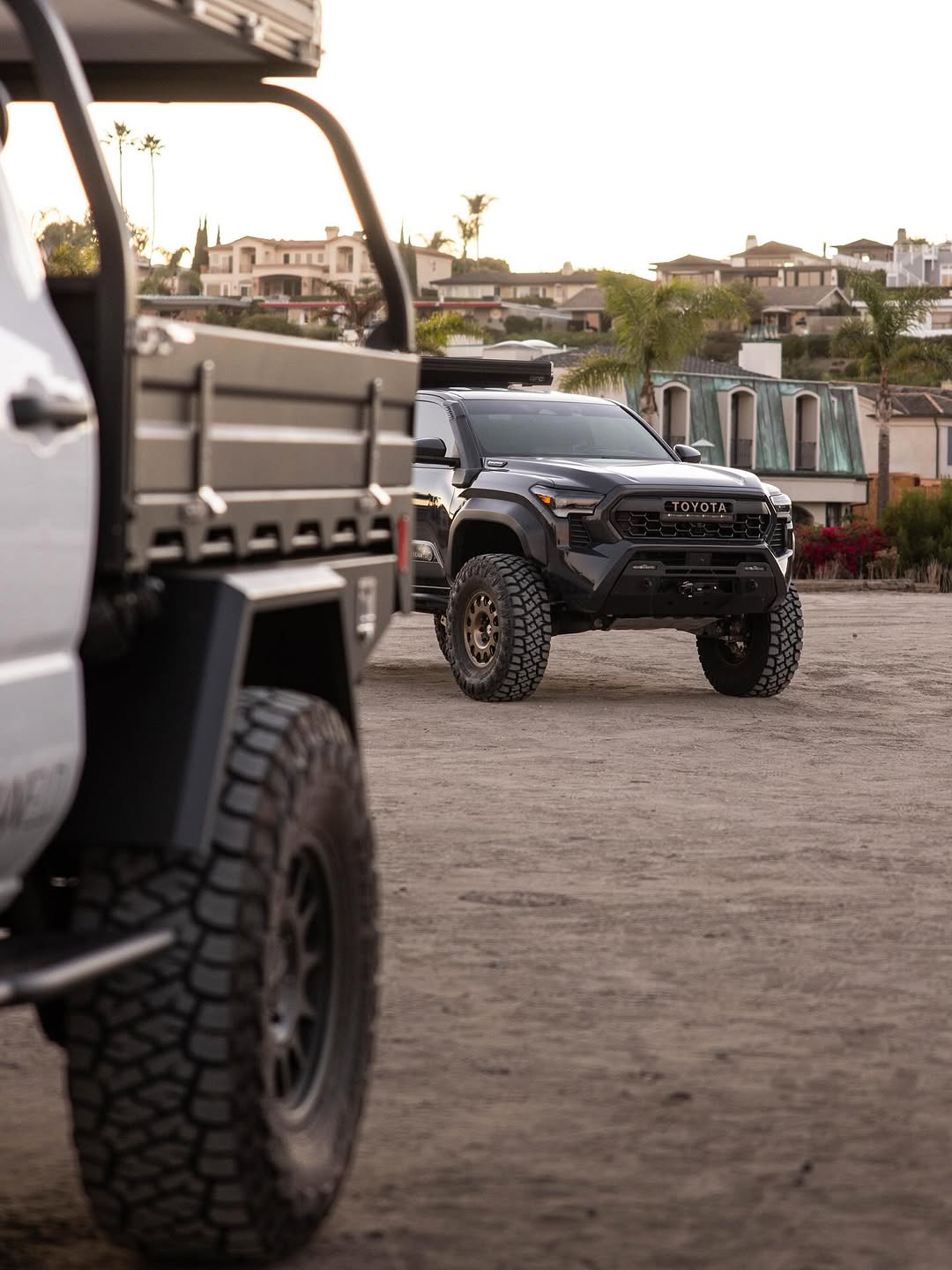
Final piece was adding a CAMTuning Performance custom tune via the COBB Accessport. I covered the Accessport in detail in the uninstall/reinstall guide. CAMTuning’s flash optimizes throttle response, shift points, and torque delivery curves for the i-FORCE MAX platform. It is a remote tune: you ship data logs, they send calibrations, and you flash through the Accessport.
Running the CAMTuning tune with portal axles and Sport/Tow-Haul mode on the I-17 climb to Flagstaff: no more battery level dips. Optimized shift logic, portal gearing, and aggressive drive mode together keep the engine producing enough power to simultaneously climb, charge, and run the inverter. Starlink stays connected the entire drive. Battery gauge stays stable through grades that previously caused progressive depletion.
Overall, the truck just climbs better. Portals combined with the CAMTuning flash add noticeable power and confidence on grades with heavy 37-inch Toyo RT Pros and the full weight of the GFC. Tuning compensates for the added rotational mass of the portal gearboxes and oversized tires in a way that the stock calibration does not.
This is the setup the truck runs now. Portals, Sport or Tow/Haul depending on the situation, CAMTuning flash active. Starlink stays plugged into the bed outlet full time. It has been reliable through every climb since.
What This Means for Other Tacoma Owners
Not everyone has portal axles and a COBB tune. Here is what applies broadly:
If you are running a low-draw device off the 120V outlet (like a Starlink Mini, a phone charger, or a small cooler), the system works well for highway and camp use. You will only notice limitations during sustained, loaded climbing.
If you are running higher-draw devices (a portable fridge, power tools, or a high-wattage charger), the 2400W capacity is real but the battery’s ability to sustain it during heavy driving is limited. Plan for the engine to cycle on frequently when parked, and expect power management trade-offs during demanding driving.
Sport/Tow-Haul mode helps and costs you nothing. If you are climbing with the inverter active, switch to Sport or Tow/Haul. Higher RPM and more aggressive shift logic give the battery more breathing room.
Modified sine wave on gas models is a real limitation. If you plan to charge lithium battery packs, run sensitive electronics, or power anything with a battery management system through the AC outlet, the hybrid’s pure sine wave inverter is significantly more compatible. This alone is a reason to spec the i-FORCE MAX if AC power matters to your use case.
Next Steps for This Build
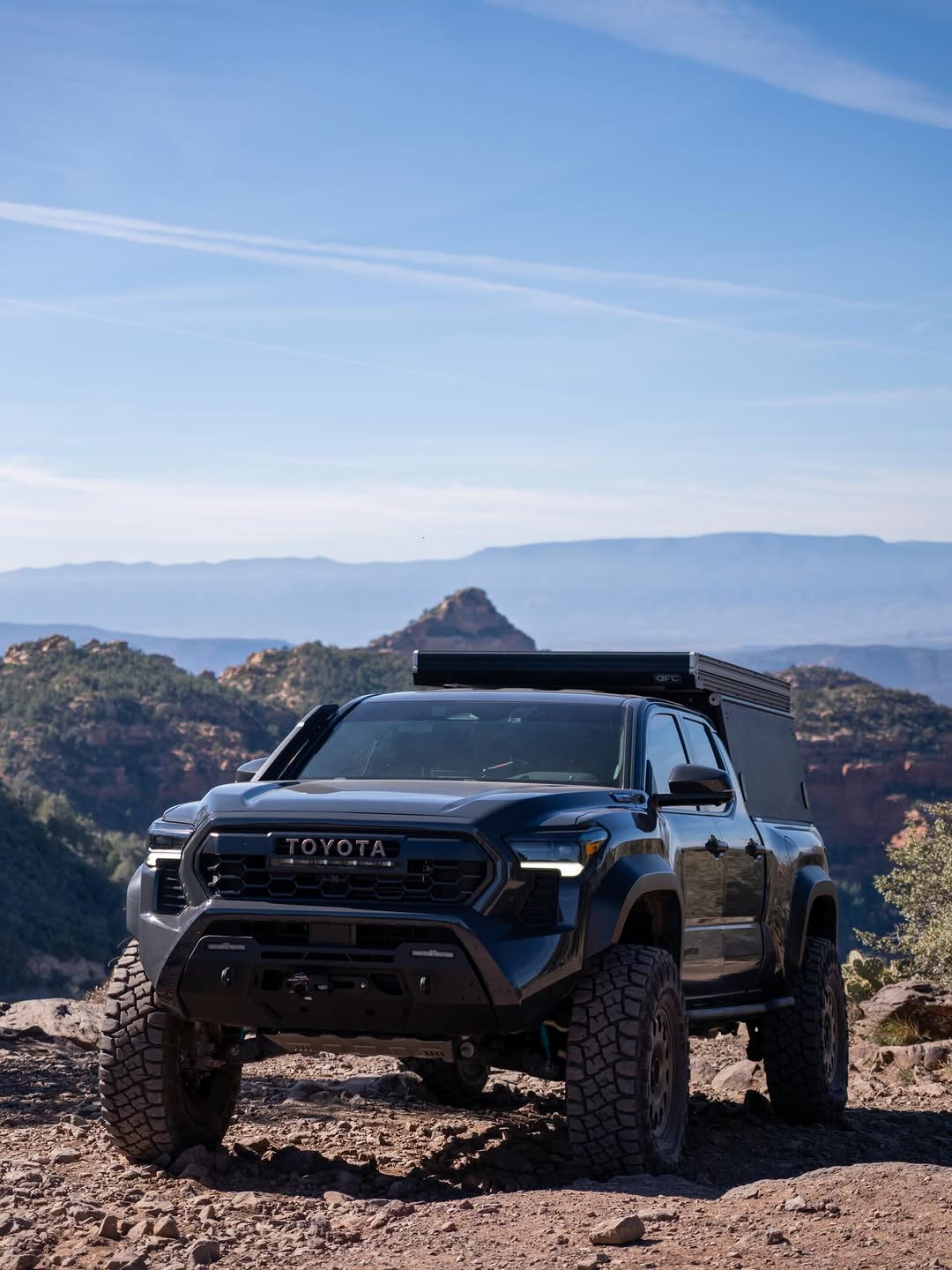
Long-term, the solution is to stop relying on the truck’s inverter for camp and accessory power entirely.
GFC V2 Pro is being upgraded to the GFC V2 Max, which provides more interior space and a proper platform for an integrated power system. My plan is a roof-mounted solar array on the camper feeding a dedicated lithium battery system inside the GFC. Starlink, interior lighting, USB charging, and any other camp electronics would run off the GFC’s own power, completely independent of the truck.
This approach eliminates every issue described in this article. No reliance on the hybrid battery. No power loss during climbs. No Goal Zero overheating in the Arizona heat. Truck’s 120V outlet becomes a backup or supplemental charger, not the primary power source.
Solar on the GFC roof charges the lithium battery during the day. Battery powers everything at camp overnight. If you need to top up faster, plug the battery charger into the truck’s AC outlet on flat highway where the system has spare capacity. It is the best of both worlds: independent power when you need it, truck power when it is available.
That build is coming. When it is done, I will write it up here.
My Verdict on the 2400W Inverter
Toyota’s 2400W inverter on the i-FORCE MAX Tacoma is a genuinely useful feature that works well in most scenarios. For camp power, charging, and running low-draw accessories while cruising, it delivers. Pure sine wave output on the hybrid is a meaningful advantage over the gas model’s modified sine wave.
Where it falls short is during sustained high-demand driving, specifically long mountain climbs with a loaded truck. At just 1.87 kWh, the NiMH battery is small, and when the engine is working at capacity for propulsion, there is not enough headroom to simultaneously charge the battery and power the inverter. This is a physics problem, not a design flaw. Prioritizing propulsion over keeping your Starlink connected is the right call.
Combining portal axles, Sport/Tow-Haul mode, and a CAMTuning flash solved it for this truck. Your mileage will vary depending on your setup, your load, and the grades you are climbing. But the principle applies: anything that keeps the engine producing more power relative to demand (lower gearing, higher RPM, optimized shift logic) gives the battery more room to sustain the inverter during climbs.
If you are building a Tacoma and AC power is part of your plan, spec the i-FORCE MAX. Then plan your power system around its strengths and limitations, not around the number on the spec sheet.
Some links in this post include referral codes from brand partners. All testing, opinions, and conclusions are based on my own experience with these products on this truck. Nothing in this article was reviewed or approved by Toyota, COBB, CAMTuning, Goal Zero, or any other company mentioned.
Full build specs: truck.bdigitalmedia.io/build
Instagram: @portal.hunter
COBB Accessport Guide: Uninstall/Reinstall Walkthrough